05 June 2010

Library of Congress: Yiddish, Jewish folksongs

The Canada Collection in the Archive of Folk Culture at Library of Congress (Washington, DC) includes the three parts of the famous Ruth Rubin Collection of Yiddish Folksong and Folklore.


The collections include song title, singer and recording location.

Part I (AFS 13,504-13,553) includes 50 7-inch tapes (about 25 hours) with Chassidic, children's games and songs, ballads, humorous, lullabies, Zionist, and other types of songs recorded primarily in Montreal, Toronto and New York by Rubin with additional recordings in London, England and Tel Aviv.

Part II (AFS 14,516-14,555) runs about 20 hours, primarily recorded 1947-67 in New York City, Montreal, Toronto, London and Tel Aviv.

This part offers songs created inside and outside of America, mixed language songs, dancing and drinking songs, love songs, ballads, soldiers and wars, Hebrew, Yiddish, World War II, Yiddish art songs; songs from Europe, USSR and the US.

Part III includes 31 7-inch tapes recorded 1950s-1960s by Rubin in New York, Canada and Israel, and by Norman Cazden in Connecticut 1954-1956.

Read more detailed information about the recordings here.

03 June 2010

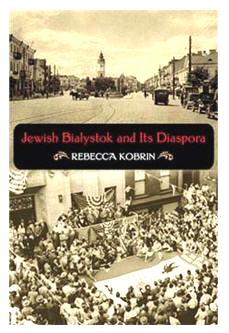
Book: 'Jewish Bialystok and Its Diaspora'

My great-grandmother Rebecca Fink (aka Regina Halpern Weintraub) was born in Skom Bobl, athough she lived in Suchostaw (Galicia->Poand->Ukraine).

Where?

My grandfather, Szaja (Sidney) Fink, always said she was from Bialystok and included the other place as well. No one ever heard of it. I assumed it had long ago disappeared as a neighborhood swallowed up by beautiful downtown Bialystok.

Years ago, on a visit to the Family History Library in Salt Lake City, I checked out the Slavnik Geografnica. This multi-volume Polish-language work was published at the end of the 19th century and includes references for many "dots on the map," hard to find elsewhere.

Imagine my surprise to find not only Rebecca's hometown but also entries for our Talalay towns of Mogilev, Zavarezhye and Vorotinschtina. Of course, the spellings were in Polish (Vs represented by Ws, and other substitutions.

There is now a remarkable book covering Bialystok, its history and diaspora throughout the world.

"Jewish Bialystock and its Diaspora," by Rebecca Kobrin, published by University of Indiana Press, and covering the city and its immigrants who settled throughout Europe, the US, Canada, Israel, Australia and South America.

Kobrin has spoken at past international Jewish genealogy conferences.

The Russell and Bettina Knapp Assistant Professor of American Jewish History at Columbia University, Kobrin has also spoken to Jewish genealogy societies about landsmanshaftn and these organizations' connections to the old country.
The mass migration of East European Jews and their resettlement in cities throughout Europe, the United States, Argentina, the Middle East and Australia in the late 19th and early 20th centuries not only transformed the demographic and cultural centers of world Jewry, it also reshaped Jews' understanding and performance of their diasporic identities.

Rebecca Kobrin's study of the dispersal of Jews from one city in Poland - Bialystok - demonstrates how the act of migration set in motion a wide range of transformations that led the migrants to imagine themselves as exiles not only from the mythic Land of Israel but most immediately from their east European homeland. Kobrin explores the organizations, institutions, newspapers, and philanthropies that the Bialystokers created around the world and that reshaped their perceptions of exile and diaspora.
If your family hails from Bialystok, this is the book for you. Read more here.

Florida: FLorida State Gen Society conference, November 2010

The Florida State Genealogical Society (FSGS) is planning for its 34th conference in November 2010, at the Hyatt Regency, Sarasota.

Maureen Taylor - The Photo Detective - will be the keynote speaker and give four presentations. The event has a functioning blog.

The event is scheduled for November 12-13 and the Call for Papers ends May 28. Interested in presenting? Here's the information.

The Florida State Genealogical Society (FSGS) is accepting program proposals
for the 2010 Conference (the 34th Annual FSGS Conference) which is scheduled to
be held 12-13 November 2010 in Sarasota, Florida.

Among the topics being considered are lectures on Computers/Technology, Beginning Genealogy, Online and General Research Sources, (i.e. New Family Search, Footnote, Ancestry.com, etc) Florida Research (i.e., history, available records, repositories) Ethnic or Religious Groups, Immigration/migration, Society Management (including society websites, technology and publishing) and broader genealogical topics including methodology, problem solving, publishing, military records, land records, etc.

Submit the following for the one-hour sessions (including 10 minutes Q&A):

1. The title of the lecture and a brief, but specific, outline and/or abstract.
2. Short summary for the program schedule (one or two sentences).
3. Audience skill level (i.e., beginner, intermediate, advanced or any mixture.)
4. Speaker's name, address, telephone number, fax number and e-mail.
5. Brief speaker's biography (150 words or less)
6. Brief resume of recent lectures the speaker has given.

Camera-ready syllabus material (due October 1) is required for each presentation (lecture, seminar or workshop). The syllabus will be distributed at the conference.

Each speaker may submit up to six proposals, but may only present a maximum of three sessions. Accepted speakers will receive a limited compensation package).
Send proposals as PDF or Word doc to the FSGS Conference Chair Cindy Hineman, who will also answer any conference-related questions.
For more information on the FSGS, click here.

02 June 2010

Pennsylvania Dutch: Ashkenazi, German encounters

Matt Singer has an interesting idea.

He's writing an independent project on the encounter between Ashkenazi Jews and Pennsylvania Germans in Pennsylvania Dutch Country as a material culture analysis.

A Penn State American studies doctoral student, his project should be of interest to Tracing the Tribe's readers. Matt was happy to share additional information with me.

He plans to document and analyze material culture reflecting the encounter between Pennsylvania Germans and Yiddish- and German-speaking (Ashkenazi) Jews from Central and Eastern Europe who settled in the so-called Pennsylvania Dutch Country from the 18th through early-20th centuries. The area is centered in Lancaster, Lebanon, and Berks counties but encompasses most of southeastern and central Pennsylvania.

While Pennsylvania Germans and American Jews have both been the subjects of extensive scholarly research, this particular history - which focuses on the interaction and influence between two Germanic people whose separate diasporas brought them to Southeastern and Central Pennsylvania - has not been studied, he says.

Matt also plans to incorporate and focus on fraktur (example left), a text-based Pennsylvania-German art-form, as part of this study.

Fraktur (example left) is the decoration of paper with calligraphic texts and related designs, figures and symbols, using pen and ink and/or watercolors. Click here (a gallery of examples and many other articles) or here for another article. The first link has many examples of this vibrant folk-art that was used for many types of documents.

Says Matt, a small but significant number of Jews worked as itinerant fraktur artists and scriveners. They functioned much like countless Jews who - typically in their earliest years in the US - earned their livelihoods as peddlers. However, traveling fraktur artists and scriveners, unlike most peddlers, left surviving evidence of their work.

A Google search for "jewish fraktur" turned up a mention in Irwin Richman's book "the Pennsylvania Dutch Country." Pages 57-58 offer information on this variety and mentions two artists, Martin Wetzler who drew a Star of David on his creations and signed his name in Hebrew, as well as Justus I.H. Epstein who lived and worked in Reading.

Fraktur incorporating Hebrew words and phrases was created by Christian Hebraists, and at least one example was made by a Pennsylvania German artist for a Jewish patron.

Finally, through the examination of fraktur in relation to traditional Ashkenazi-Jewish forms such as the ketubah (marriage contract), wimpel (Torah binder), illustrated prayer-books, and mizrachim (a wall-hanging that indicates the direction for prayer - East, mizrach), Matt will search for artistic motifs, approaches, and intentions shared (or not shared) by Pennsylvania Germans and Ashkenazi Jews and their continuity (or discontinuity) as the two distinct yet geographically and culturally related groups established new lives, communities, and cultures in the New World.

Matt, like many of us first became interested in genealogy after watching "Roots" in 1977, as a young teenager. Later, the emergence of JewishGen in the 1990s "turned this interest into a passion."

His paternal SINGER line was from the Ponevezh (Panevezys) area in Kovno Gubernia, Lithuania.

Says Matt, according to a distant cousin (now deceased) who was equally obsessed with genealogy and family history, the family moved from East Prussia to Lithuania around 1840.
"Such a migration pattern is slightly counterintuitive," he says, "and I’ve never been able to document it.

What I do know is that my great-grandfather David Singer immigrated from Neustadt Ponevezh, Lithuania, in 1886 and seemed to have moved directly to Middletown, Dauphin County, Pennsylvania, a small Pennsylvania-German town outside of Harrisburg (where much of the family eventually settled).
His primary maternal line - the KLEINMAN/N) - were from the Kurland/Courland region (now southwestern Latvia) which, though absorbed by Russia in the Partition of Poland in 1795, was German in language and culture and not part of (although not far from) the Pale of Settlement.
My great-great-grandfather Abraham Kleinman immigrated from Friedrichstadt (now Jaunjelgava), Kurland, in 1887 and first settled in Lancaster, the heart of “Pennsylvania Dutch Country,” and later lived in several smaller towns in the region before ultimately settling in Harrisburg.

Counting my older brother’s children, five generations of my Jewish family (I’m also one-quarter Austrian and German Catholic by descent) have been born in “Pennsylvania Dutch Country,” and seven have lived in it (my great-great-great grandparents Elias and Sarah Rachel Kleinman—Abraham’s parents—followed their son, immigrating here in 1891).
All of Matt's Jewish ancestors were Litvaks, although he adds:
The Kleinmans represented a sort of German-Litvak hybrid, as did the Singers, I suppose, if they really did move from East Prussia to Lithuania ), as seems to be the norm in the vicinity of Harrisburg (of course, the Litvaks were preceded by Jews from southern Germany ). I believe the same is true of all of Pennsylvania Dutch Country—but that’s a matter for research far from completed!
Matt's geographical locations and names of interest include East Prussia, Singer; Courland, Kleinman, Toor, Tuch, Singer; and Lithuania, Singer, Tuch, Gerber, Garonzik, Ringer and Blau.

Do you have any written memoirs inherited from immigrant ancestors who settled in the area?

Would you share them with Matt? Readers are welcome to contact him.

France: Revue du Cercle de Généalogie Juive, new issue

The Cercle de Genealogie Juive (Paris, France) has published the new edition of its journal, Revue du Cercle de Genealogie Juive.

Issue 101 (January-March 2010) includes:

-- Jews in Hungary: History and Genealogy, by Georges Graner, who covers Hungarian and Jewish history from the 14th century through the Holocaust, and provides steps to obtain information on searching Jewish ancestors in Hungary.

-- Jews in Ensisheim (Alsace) in the 18th century, by Denis Ingold, who describes how Jews returned to the town after Hapsburg possessions in Alsace were returned to the King of France following the Thirty Years' War (1648). Later, Jews migrated again to more attractive and welcoming cities like Breisach and Metz.

--Salomon Schueler (1870-1938), prominent rabbi: from Hegenheim to Saint-Louis (Alsace), by Lea Rogg, offers the life and times of the first rabbi of Saint-Louis (Upper Rhine, near the Swiss border). Educated at Berlin's orthodox Hildesheimer Yeshiva, he contributed to the community as the city became more modern.

-- Current state of Jewish genealogy in Germany, by Ernest Kallman. The article provides information on the pre-1800 period when vital records recording did not exist, on the Jewish population of the country and attitudes towards the Jews since 1945, the appearance of researchers and their work, and a case study on a step-by-step search for Dilsheimer ancestors (which was in the journal's previous issue). it also attempts to show what is necessary for successful research particularly when the researcher is linguistically-challenged.

For more information, send an email or view here The site is in French, but Google Translate offers a reasonable alternative.

New York: Naturalization documents, June 13

Ever wondered about the naturalization process and about the relevant documents?

The next meeting of the JGS of New York will focus on just this topic with speaker Phyllis Kramer, on Sunday, June 13.

The program begins at 2pm at the Center for Jewish History, 15 West 16th St., New York City.

Naturalization is a voluntary process which enables an alien to become an American citizen. Documents after 1906 reveal birthplace, birth dates, immigration and family. After 1924, photos were required.

The program will cover the history of naturalization in the US, the four documents produced, derivative citizenship for women and children, the myriad of federal, state and county courts involved, and how to find the documents.

The session will outline a research plan starting with clues from the census, clues from manifests, the court system, explain what's online, what's in archives and share experiences with the governmental agencies involved.

A practicing genealogist, her primary interest is Eastern European Jewish research.

She holds an MBA (Fordham University) and a BS (Cornell). She retired from IBM as a business consultant designing and implementing client document imaging systems.

For more information, visit the JGSNY website.

01 June 2010

Scorecard: The genealogy industry

Family Tree Magazine has put together an interesting media kit.

Media kits are aimed at advertisers to persuade them to place ads in certain publications. This one provides many juicy gems for those fascinated by this field and its growth. Most stats are from 2007 surveys; the most recent is a 2008 survey by the magazine.

Tracing the Tribe believes that newer studies would show even better numbers in every category. The planner indicates what geneabloggers already know - that millions of people, in many countries, are discovering that the Internet offers accessible genealogy research.

The 2010 Media Planner has six sections: The Genealogy Market, Family Tree Magazine's Audience, 2010 Editorial Content, Editorial Calendar, Advertising Information and Contacts. Download it here (it's a 42-page PDF, so takes a bit of time).
-- 78% of Americans say they are interested in learning more about their family history.
-- Half of American families have ever researched their roots.
-- Genealogy isn’t just for older Americans: 83% of those aged 18-34 are interested in learning their family history, followed by 77% of those 35-54 and 73% of Americans over age 55.
-- 500,000 genealogists belong to more than 500 Federation of Genealogical Societies member groups.
-- 651,500 people have taken a genetic genealogy test.
-- 1,900 people visit the Family History Library in Salt Lake City every day.
-- 1 million+ people visit the National Archives annually.
-- The National Archives and its regional research facilities receive 1.1 million written research requests a year.
Some number for online roots digging:

-- 9.1 million US web visitors use genealogy websites each month.
-- 35 million Americans are interested in online genealogy research.
-- Four of the 10 most-visited genealogy websites are primarily fee-based services.
Sources for data, according to the media planner, include zOmnibus Survey, MarketTools, February 2007; Ancestry. com press releases; Federation of Genealogical Societies; The Genetic Genealogy blog, Nov. 6, 2007; Family History Library Media Kit; NARA 2005-2007 annual reports; comScore 2007 data; Pew Internet and American Life Project, 2007; ProGenealogists Internet study.

As far as the magazine's own readers:
-- 60% consider themselves intermediate genealogists; 24% are beginners.
-- have been researching for an average of 13 years, and spend an average of 6 hours and 10 minutes each week on genealogy activities.
-- 76.7% stay informed about genealogy by reading magazine articles and ads. [TTT: Not blogs?]
-- 90% use the Internet more frequently than any other research tool or method.
-- On average, they do 45% of their genealogy research online.
Genealogists spend on their research - a fact we can all relate to personally!
-- 74% spend $200+ per year on genealogy.
-- Most is for online subscriptions; then books, CDs and magazines; then research-related travel.
-- Despite the economy, 79% are not decreasing their genealogy spending.
-- 60% feel that prices of genealogy products and services are fair.
Results from surveys in 2004 and 2008 indicate that of those who read the magazine:

-- 74% spend $200+ per year on genealogy.
-- 82% visited a library or archive
-- 33% visited a courthouse
-- 73% visited a cemetery
-- 41% visited a Family History Center
-- 54% attended a genealogy class, meeting or conference
-- 48% participated in a genealogical or historical society
-- 50% traveled between 50-300 miles
-- 31% traveled more than 300 miles
-- 96% searched a free online database
-- 78% searched a fee-based online database
-- 60% requested a record copy from a repository
-- 61% posted on an online message board
-- 21% listened to a podcast
-- 32% watched an online video
-- 64% bought a book or CD
-- 43% bought desktop or Web-based software
-- 47% bought archival preservation materials
-- 22 % bought electronic equipment
How many of these have you done?

Thanks to Randy Seaver and Thomas MacEntee who posted early in May about this.

31 May 2010

Collecting the stories: Journals to give

We've all seen baby books. Everyone gets them or gives them. New parents write the details of their child's milestones, add pictures and documents. They are preserved and shared with children and grandchildren.

Tracing the Tribe just received a press release from Sand Dune Books about its line of 15 "Between me and you - A few things I've been meaning to ask" journals to give to, and be completed by, mothers, fathers, grandparents, aunts, uncles, siblings and significant others.

Sand Dune says that these books might "help us all get just a little bit closer to the people we care about while having fun at the same time." The company's president, Winston Simmonds Jr., developed the series because he wanted to have something personal and meaningful from his own parents, who responded enthusiastically when they received his hand-made version.

Although I haven't seen one yet (maybe I'll see them on my trip), they seem like a good way to get started on the path to family history and the price - $14.95 plus shipping - won't break anyone's bank. They are spiral-bound with no page numbers and have blank pages for adding additional questions or photos.

Current titles (more are planned) are "Between Me and You MOM a few things Iʼve been meaning to ask" also comes in versions for DAD, GRANDMA, GRANDPA, HONEY, GIRL, SISTER, BROTHER, DAUGHTER, SON, AUNT, UNCLE and FAMILY REUNION. There are also MAMA and PAPA versions in Spanish.

MOM questions - Simmonds says GRANDMA and GRANDPA questions are similar - include:

-- When you were a kid, what did you want to be when you grew up?
-- Tell me about the first time you met Dad.
-- Was there anything that I did while growing up that reminded you of yourself as a child?
-- How do you think we are different?
-- What are your favorite memories of your mother? Of your father?
-- What are your memories of the day I was born?
-- Did you have and role models when you were a teen? Who were they?
According to the press release,

Guess what! Our parents were real people and actually had real lives before they had us. And let's face it. We all keep meaning to ask them about some of their teen experiences or childhood relationships or even questions about ourselves and most times never quite get around to it. How fun and enlightening would it be to have a journal containing their handwritten responses to all of those questions youʼve been meaning to ask for years.
The books are in gift and card shops or can be ordered online at the link above. There's also a nice discount if you buy two or more - see the website link above.