Showing posts with label New Mexico. Show all posts

26 March 2011

New Mexico: Genealogy 'superstars' to speak, April 2-3

New Mexico family history researchers are in for a treat when two major genealogy superstars will speak on Saturday and Sunday, April 2 and 3.


Bennett Greenspan (left) - founder and CEO of FamilyTreeDNA.com - and Dr. Steve Morse - of One-Step pages fame - will be in Albuquerque next weekend to speak at two major events, co-sponsored by the New Mexico Jewish Historical Society, which is revamping and expanding its genealogy programming. The NMJHS is now a member of the IAJGS.

-- Saturday, April 2, from 10.30am-3.30pm, the Rio Rancho Library's Loma Colorado main branch will host a free "Blast Into Your Past" - a general program aimed at beginners and recent family history researchers, athough the entire genealogical community is invited to attend.

-- Sunday, April 3, from 11am-1pm, the Jewish Community Center in Albuquerque will host both speakers for sessions spotlighting Jewish issues and topics in genetic genealogy with Bennett, and One-Step helpful tools, such as demystifying the Jewish calendar, with Steve. The program is open to the public and all are invited to attend.

See below for more information on each event.

Judging from responses already received by organizers, attendees will be coming from many areas of the state for both sessions.

"Blast Into Your Past" will provide a good basic introduction to family history with the superstars and local experts. Beginning at 10.30am and running through 3.30pm - attendees should bring a brown-bag lunch - there will be an introduction to genetic genealogy with Bennett Greenspan, followed by Steve Morse's intro to the more than 200+ tools on his site.

After a short lunch break, there will be three additional sessions:
-- Michael Barger will present genealogy basics.
-- An ethnic research panel (Hispanic, Jewish, and others) will field questions from attendees and supply information on how to find additional information. Lionel Rael of the Hispanic Genealogy Society will be on this panel, along with others.
-- Social media for family history researchers will be presented by Schelly Talalay Dardashti.
There will also be an overview of genealogical resources at the library, including databases and subscription sites available in the computer lab or accessible at home for library card holders.

There will be time for Q&A.

On Sunday, April 3, both men will speak at the Jewish Community Center in Albuquerque from 11am-1pm. Bennett will address genetic genealogy through a focus on Jewish history and share stories of discoveries, while Steve will focus on One-Step tools that may assist Jewish family history researchers, such as demystifying the Jewish calender.

Again, the library program is free and its general topics are aimed at beginners and those who are recent to family history research. The JCC program - with more of a Jewish genealogy focus - is free for NMJHS members, and $5 for others (the fee may be applied to a one-year NMJHS membership).

We believe that many attendees on Saturday will want to know more about these topics and will also attend the Sunday program, which is open to the public.

The NMJHS, the Library and New Mexico genealogical community is looking forward to this "superstar" weekend. I'm looking forward to greeting Tracing the Tribe readers at both events.

For more information, click on the NMJHS website, or send an email.

02 March 2011

Back home again!

It is great to be back home again in New Mexico!

WDYTYA Live 2011 was a great experience - despite feeling a bit under the weather - and I managed to see some of my Bombay Dardashti cousins and Persian and British friends.

Genner personalities also included Lisa Louise Cooke (blogging for Family Tree magazine), photo detective Maureen Taylor, and Dick Eastman. Dick will be back in the UK in about six weeks for the one-name guild event.

Tracing the Tribe, of course, will be back in the UK in May for the Society of Genealogists' Centenary Conference and the JGS of Great Britain's Manchester one-day conference, followed by the National Genealogical Society's event in Charleston.

I'm trying to get things organized during March, while at home.

I'm already looking forward to next year's event. Wondering when the NBC version of the show will spawn a US-version of WDYTYA Live here at home. The event is so different from what we experience here at gen conferences and it might really take off as it would attract those who are really just beginning and want a "gen lite" experience.

Even better, our daughter arrived yesterday for a visit. Unfortunately, she seems to have the "bug" that is going around New York (and many other places!).

Chicken soup seems to be on the menu over the next few days, and also hoping it helps take care of this still coughing blogger and the bug from Salt Lake City!

Sorting through what seems like a thousand emails, notices from Jamboree, submissions to other conferences.

27 January 2011

On the Road: Genealogists plan speaking tours

Are we coming to your neighborhood?

This is the time of year when many genealogy speakers are focusing on finalizing their schedules for the next few months.

Many - including Tracing the Tribe - will speak at both major conferences and local venues. All of these events are wonderful opportunities to meet, greet and learn from so many individuals speaking on a wide array of topics.

Tracing the Tribe will be speaking in the US, UK and Canada. This year will be much easier as we are now US-based, making it much easier to travel to events and return home without being away for extended periods of time. My presentations include DNA genetic genealogy, creating virtual communities and introductory sessions, and the current schedule looks like this:

FEBRUARY
6 - Rio Rancho, NM - DNA genetic genealogy and family history
10-12 - Salt Lake City, Utah - RootsTech 2011
13 - Albuquerque, NM Jewish community education event - A Taste of Honey -
24 - London UK - JGS of Great Britain
25-28 - London UK Who Do You Think You Are? Family History Fair

APRIL
2 - Rio Rancho, NM - Genealogy Library Day ("Blast into the Past"), Loma Colorado Branch

MAY
7 - London UK - Society of Genealogists' Centenary Conference
8 - Manchester UK - JGS of Great Britain, Manchester Regional Conference
11-14 - Charleston, SC - National Genealogical Society Conference

JUNE
10-12 - Burbank, CA - Southern California Jamboree
19-23 - Montreal, Canada - Association of Jewish Libraries

Our good friend and MyHeritage.com colleague Daniel Horowitz and I will both be speaking at the major conferences, at the Albuquerque JCC Taste of Honey event February 13, and at a special double-header February 24 for the JGS of Great Britain before WDYTYA Live! opens.

Daniel's upcoming schedule offers information-packed talks covering a broad range of topics - from MyHeritage features, technology, genealogy school projects, Israel resources and others.

FEBRUARY
8- Utah Jewish Genealogical Society, Salt Lake City, UT
10-12 - RootsTech, Salt Lake City, UT
13 - JCC of Greater Albuquerque, Albuquerque, NM
14 - CSU/ JGS of Georgia, The Breman Museum, Atlanta, GA
24 - JGS of Great Britain, London, UK
25-27 - WDYTYA Live, London, UK

MARCH
29 - JGS of Dayton, Ohio
31 - April 2 - VISIT Ohio Genealogical Society Conference

APRIL
5 - JGS of Cleveland, Ohio
6-9 - VISIT 11th New England Regional Gen Conference
10 - JGS of New York, Center for Jewish History, Manhattan
11 - Association of Professional Genealogists NY, NY
14 - JGS of North Jersey, New Jersey
24 - JGS of Long Island, Long Island, NY
26 - Bernards Township Library, Basking Ridge, NJ

MAY
2 - JGS of Greater Philadelphia, Elkins Park, PA
3 - New York Genealogy PC Users' Group, Manhattan, NY
10-14 - VISIT NGS Conference, Charleston SC
15 - JGS of Greater Washington, Washington DC, Washington DC

For more information on Daniel's schedule and the specific talks at each location, contact him, or see his personal website.

Tracing the Tribe looks forward to greeting readers!

17 December 2010

Wordless Friday: Out our window

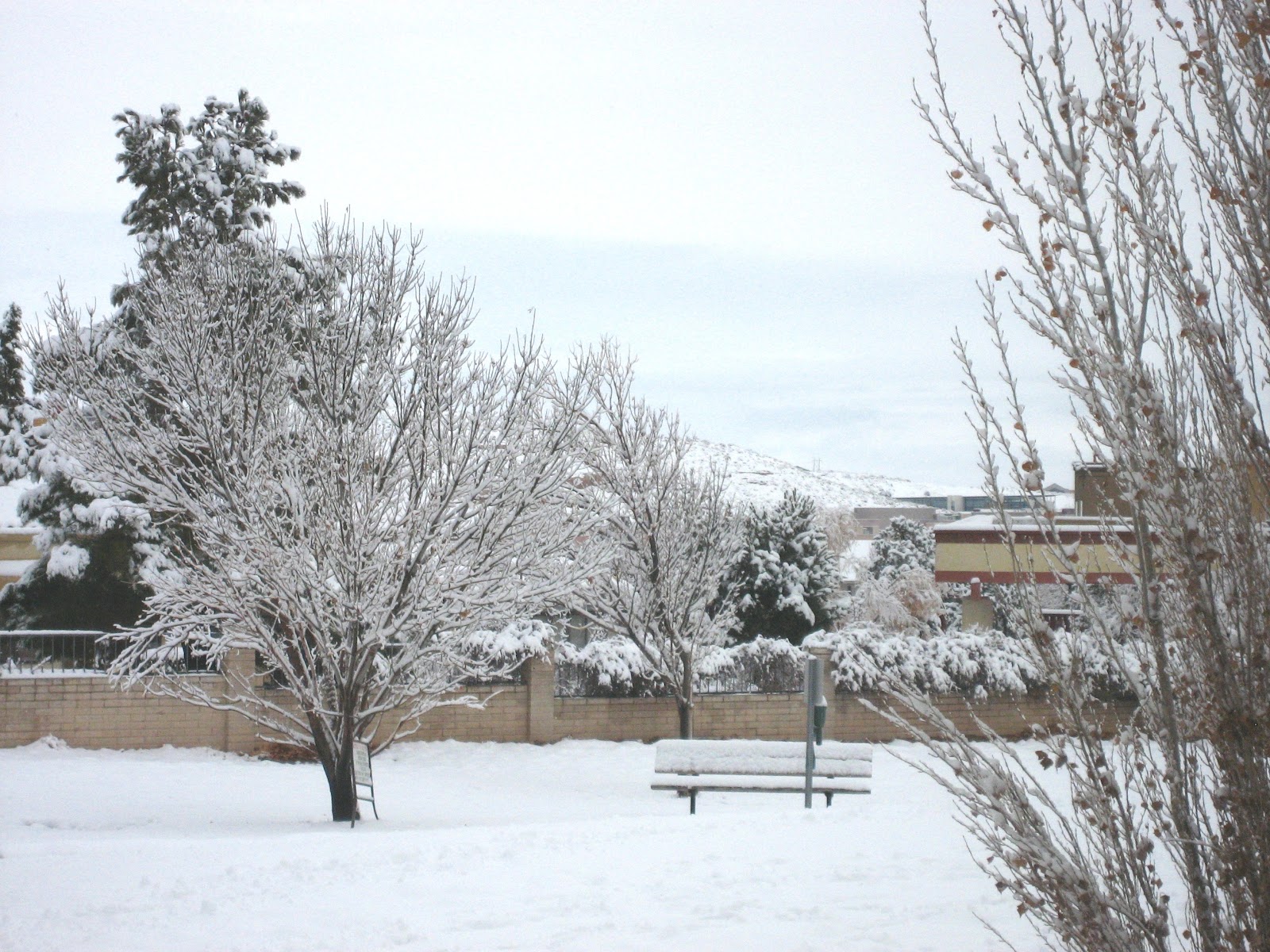
Although the blogger theme is Wordless Wednesday, Tracing the Tribe doubts the snow will still be here then, so here's our morning panorama:


Patches of blue sky are already peeking out from the clouds, so the snow may disappear even sooner.

Tracing the Tribe understands that for those readers who live with this all the time, it may not be as much fun!

For us, it is still a beautiful novelty.

16 December 2010

New Mexico: It's snowing!

Today has been very different.

After a long time in the Middle East, Tracing the Tribe is watching snow come down!

This morning began with cold rain and, within just the past 10 minutes, it has begun snowing ... and sticking!

The weather reports predicted this, and since I barely remember how to drive in the snow - it's been a very long time - yesterday we made a supermarket run in case we had to stay home for a day or so.

Now I have no excuse but to catch up on a mountain of email and blogging.

I don't think our snowfall will rival my good friend Thomas MacEntee's Chicago blizzard but - for me - this seems quite enough!

Mother Nature also seems to be preparing me for my February appearances at the RootsTech conference in Salt Lake City!

14 November 2010

Where in the world is Schelly?

Readers have been wondering why Tracing the Tribe has been so quiet for the past week or so.

We have just transplanted back to the US - to New Mexico, known as the Land of Enchantment.

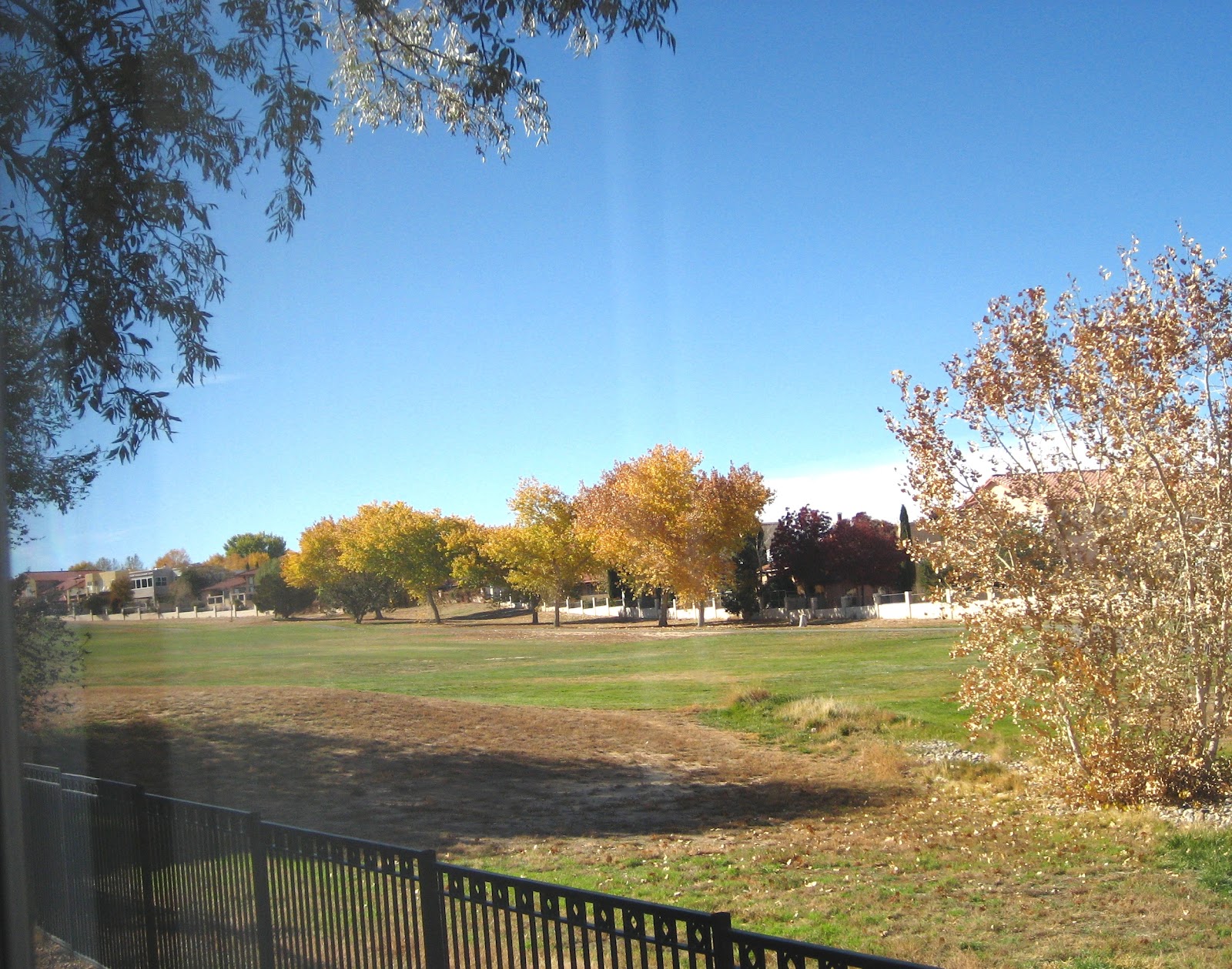
What is it like here in mid-November? Beautiful blue skies, bright sunshine, clean clear air, a bit nippy during the day, but comfortable! This was the view from our living room about five minutes ago.

We've spent the past few days getting settled in our new place and restocking with the essentials of life.

Everyone we've met has been very friendly and interested in the fact that we moved here from Israel. Everyone has a story of a connection, either because of their own family history (Sephardic, Converso) or their support for Israel. I've met such interesting people in just the first few days.

For a genealogist - and a Jewish genealogist in particular - meeting our next door neighbor was fortuitous. This isn't New York City, where even the Italians are Jewish (or so we used to say!), and the Jewish population is spread out across the city, so it was quite a surprise to meet our MOT neighbor.

She has roots in Nesvizh, Belarus. Their name, she reported, was Odiansky, changed to Gordon at Ellis Island (NOT!), and that she can't find information because everything over there was destroyed (NOT!). We plan to sit down this week and see what we can find in the Belarus and other records. She also has distant cousins in Ramat Gan (adjacent to Tel Aviv).

We haven't had too much time yet for touristy things, but hope to get to some places next week.

Now that our internet, cable and phones are connected, Tracing the Tribe can get back to work.

I'm also really looking forward to meeting everyone at the New Mexico Genealogy Society and the New Mexico Jewish Historical Society.

06 September 2010

New Mexico: Two gen, history conferences, October

New Mexico genealogists have two October treats in store.

New Mexico Genealogical Society Conference, Friday-Saturday, October 15-16, in Albuquerque, will be followed by the New Mexico Jewish Historical Society, Friday-Sunday, October 22-24, in Las Vegas.

The New Mexico Genealogical Society Conference is its 50th anniversary. Details: Early registration (through September 15) is $35, members ($55, others); banquet, $35; hotel, $69 per night(Marriott Pyramid Hotel). The theme is ¿Quién Eres? (Who are you?). See below for speakers. Another reason to go: The New Mexico History Museum will debut “Hilos de la Memoria,” an exhibit on oral histories relating to New Mexico.
The New Mexico Jewish Historical Society Fall Conference - the 23rd - is themed "Adventures Along the Santa Fe Trail," set for Friday-Sunday, October 22-24, at the historic Plaza Hotel in Las Vegas, NM. The focus is on the Jews of Las Vegas and Northeast New Mexico. See below for speakers. Pre-conference tours include: historical Jewish Las Vegas, Montezuma Castle and Montefiore Cemetery, the oldest Jewish cemetery in the state. For more details, send an email. Saturday night includes a 19th-century liturgical music at the old Congregation Montefiore. See below for speakers.
-------------------------------------------------------------------

Speakers: New Mexico Genealogical Society Conference

-- Paul Hutton, Ph.D, Keynote, "Billy the Kid"
Award-winning speaker and UNM history professor

-- Al Regensberg, "Migration around New Mexico"
Learn to use migratory patterns to solve the mystery of where or when your ancestors
came from; the process of reversing migratory patterns to locate appropriate Catholic parish records for genealogists with a New Mexico heritage.
-- Robert J. Tórrez, "Rio Arriba County"
Overview of a new to-be-published book on the county where New Mexico was first settled. Author, former state historian and historical lecturer.
-- Krysten Baca, "Getting the Most Out of Ancestry.com"
A genealogist on the Ancestry.com public relations and conference team, her responsibilities
have included conducting research on new content and celebrity research.
-- Jim Greene, "FamilySearch.org"
Explore how FamilySearch proposes to help curb the loss of records worldwide and increase the volume of records accessible online.
-- Krysten Baca, "Best Strategies for Researching using Ancestry.com"
Workshop and "how to" strategies on the fine points of online research.
-- Richard Melzer & Robert J. Tórrez, "Rich and Powerful Hispanic Leaders in the Rio Abajo"
Historians, authors and lecturers.
-- Rick Hendricks, "Research In and About Durango and Parral"
Researcher, author and NMSU history professor; learn how to research the archives of Durango and Parral.
-- Bennett Greenspan, "FamilyTreeDNA"
President & CEO of FamilyTreeDNA.com, Greenspan; DNA testing for Genetic Genealogy, how to pick the right person to test, understanding results and other questions regarding DNA. Bring your questions!
------------------------------------------------------------------------------------
Speakers: New Mexico Jewish Historical Society Conference

-- Susan Califate Boyle, National Park Service
"History of Hispanic Participation in the Santa Fe Trail Trade"
-- Laura Gonzales, New Mexico Highlands University
"Las Vegas: Place of Encounter"
-- Sharon Niederman, Raton
"Synagogues on the Santa Fe Trail - History of Temple Aaron (Trinidad, Colorado) & Congregation Montefiore (Las Vegas)"
-- Melanie LaBorwit, Albuquerque
"History of the Jews of Las Vegas"
-- Noel Pugasch, University of New Mexico
"The Jewish Commercial Presence in Mora County, New Mexico, 1860s to the 1940s: A Brief Overview"
-- Panel 1: Crypto-Jews in Las Vegas and Northeast New Mexico:
Isabelle Medina Sandoval, Santa Fe (Mora)
Orlando Mondragón, Santa Fe (San Luis, Colorado)
Hon. M. Christina Armijo, Albuquerque (Las Vegas)

-- A. David Scholder, Founder
"Reflections on the Establishment of the New Mexico Jewish Historical Society"
-- Panel 2: Legacy of Las Vegas’s and Northeast New Mexico’s Rich Jewish Past:
Betty Mae Hartman, Albuquerque
Gerald Meyer, Laramie, Wyoming
Nancy Paxton, Albuquerque
Mortimer Herzstein, San Francisco

-- Panel 3: Renaissance of the Las Vegas Jewish Community:
Diana Presser
Kate Immerman

---------------------------------------------------------------------------

In words that are moving for all genealogists, the New Mexico Genealogy Conference theme is taken from a poem by Sabine R. Ulibarrí, PhD. See the conference link above for the Spanish version of ¿Quién Eres?

Who Are You?

If you forget where you came from, can you know where you're going?
If you've lost your past, where is your future?

If you're a man without a history, you're a man without a future.
If you turn your back on your parents, what can you expect from your children?

If you have no kinship with your family and your community,
when you laugh, you laugh alone, when you cry, you cry alone.

A solitary present without a yesterday or a tomorrow without parentage,
without fellowship, without friends, without brothers.

How alone you are in the world, How lost in the white mist.
Alone, with your guilt on your back. Alone, with your loneliness.


We can all relate to those words.

25 August 2010

New Mexico: A frontier bar mitzvah

Readers who live in large Jewish communities don't always "get" what it's like to live in an isolated community, particularly when it comes to lifecycle events.

One year, during a ski trip to Taos, we met two young girls on the slopes. Their Jewish family lived in Taos, their father was an anesthesiologist, and their mother told us - over pizza at their home - of the shlepping involved getting the girls to Hebrew school in the winter to Santa Fe.

I only had to drive 15 minutes down Ventura Boulevard to Valley Beth Shalom (Encino, California), where snow never fell, and where our biggest problem was parking!

I just discovered this blog post, written by Lauren Reichelt of Espanola, Rio Arriba County, in northern New Mexico, describing the problems and practicalities of getting kids to Hebrew school, and of staying connected as part of a congregational family.

In Lauren's area, one must work hard to maintain Jewish connections. I think her message holds important insights for Jewish family history researchers who may understand more about their ancestors who settled in remote places.

Lauren's post addresses the challenges of Judaism in such a setting, and the stronger links formed because of the effort of dedicated parents to achieve success and maintain these connections.

Here's just some of Lauren's post. Read the complete post at the link above.

I teamed up with two other Espanola area families to help my children reach their B’nai Mitzvah ritual. It was a challenge to drive my children into Santa Fe two times a week on Wednesday and Sunday. Older children have class at six while younger children must be there by four. But my son and daughter attended school in two separate towns, Los Alamos and White Rock, thirty minutes from where I work, and an hour from Santa Fe. The Trujillo family lives in Chimayo, 15 minutes to the East of us, but also sent their children to White Rock and Santa Fe. The Bennett children attended day school in Santa Fe.

Here’s how we did it:

Early every morning my husband met Irvin Trujillo in Espanola and exchanged a child. One van headed to White Rock and the other to Santa Fe. On Wednesdays, Irvin brought one carload of children into Santa Fe at four while his wife, Lisa, dropped off the other at six. Scott Bennet, who worked in Santa Fe, picked up a carload of younger Bennett-Trujillo-Reichelts at six and drove them to his farm in La Puebla. I picked up the older carload of Bennett-Trujillo-Reichelts at 7:30 and drove to Scott’s farm. I dropped off the elder Bennett and picked up the younger Trujillo-Reichelts, dropped off the Trujillos at their weaving studio in Chimayo and drove my own children home. We were lucky if we made it by ten.

On Sundays, we took turns, meeting in a parking lot and loading kids into a van.
As various children aged out of the carpool program (or began driving themselves), moving on to high school or college, the regime became more complex. My son took the Park and Ride to Santa Fe where he was met by a rotating assortment of Temple members and driven to class. Imagine a ten year old boy standing on the sidewalk with a trombone case and a backpack full of books in a downpour waiting for his ride!


Sometimes it snowed or a child ended up on a Park and Ride going in the wrong direction. I once ended up in a ditch in Chimayo in the middle of a blizzard with a carload of cold children!
Getting the kids there wasn't the only issue.

The families of the bnai mitzvah class supported each other throughout the year, preparing and clean up after congregational meals following Friday night and Saturday services and working together to organize the parties.

At many large synagogues in North America, the bima is shared by two or three young people. At Lauren's Santa Fe synagogue, each child acts as the rabbi, leads the entire service, chants four aliyot and the haftorah, and prepares a d'var torah (sermon). Lauren writes that they want to prepare their young people to lead the community in the future.

During the bnai mitzvah year, all class parents, not only the young people, are expected to attend every bnai mitzvah, some 12-20 weekends during the year and a major commitment.

It's an inspiring story of community bonding.

Lauren Reichelt is director of Rio Arriba's (New Mexico) Health and Human Services Department.

Rio Arribo is a rural northern New Mexico county with a population of 41,200 residents in an area equal to Massachusetts and Rhode Island combined (5,858 sq.miles); 75% Hispanic, 14% Native American and 13% Anglo. The largest center, some 9,000 people, is in a 6,000-foot high valley surrounded by peaks of 10,000-12,000 feet, and it takes 3 1/2 hours to drive from one end of the county to the other.

She began getting involved in Jewish community organizing assisting Rabbi Michael J. Schudrich (another name familiar to Jewish genealogists - he is now Chief Rabbi of Poland) when she lived in Tokyo, Japan.

Read the complete post at the link above.

19 April 2010

San Francisco: New Mexico's Sephardic Legacy, April 29

Along our journey of discovery, we meet many people who inspire us, who teach us, who enlighten us as to topics that others consider esoteric.

One of Tracing the Tribe's most interesting encounters years ago was with Dr. Stanley M. Hordes of New Mexico, who specializes in Crypto-Jews of that state. He treats those involved in his research with great dignity and understanding, and his skill in genealogical research and history has enabled many links to be made.

San Francisco residents will have an opportunity to hear Stan present "The Sephardic Legacy in New Mexico: A History of the Crypto-Jews," on Thursday, April 29, at 7.30pm, at the Jewish Community Library.

During his tenure as New Mexico State Historian in the 1980s, Stanley Hordes began to hear stories of Hispanics who lit candles on Friday night and abstained from eating pork.

Hordes is adjunct research professor at the Latin American and Iberian Institute of the University of New Mexico and a Society for Crypto-Judaic Studies board member.
Puzzling over this phenomenon, Hordes realized that these practices might well have been passed down through the centuries from early crypto-Jewish settlers in New Spain. His theory was corroborated after hundreds of interviews and extensive research and led to his award-winning book on the history of the crypto-Jews in New Mexico.

Dr. Hordes will talk about the conversos from their Jewish roots and forced conversions in Spain and Portugal to their migration to central Mexico in the 16th and 17th centuries and their part in the colonization of New Mexico.
Using slides, he will describe customs and consciousness that have survived to this day, the recent reclamation of Jewish ancestry within the Hispano community, and the challenges of reconstructing the history of a people who tried to leave no traces.
His book (above left) - "To the End of the Earth: A History of the Crypto-Jews of New Mexico" - received the Gaspar Perez de Villagra Prize in 2006 by the Historical Society of New Mexico for outstanding historical publication of the year.

If you have not yet read this book, do get a copy. It is a truly fascinating read. He is also working on another book, documenting the same culture in other New World communities.

The event is co-sponsored by the San Francisco Bay Area Jewish Genealogical Society, Be'chol Lashon (In Every Tongue) and Lehrhaus Judaica.

For more information, click here.

02 February 2010

Florida: Secret Jews of the Caribbean, Feb. 4

"Hidden Jews of the Caribbean" is a symposium at Florida International University on Thursday, February 4.

It runs from 8-10pm, at FIU's Biscayne Bay campus, in North Miami, Florida.

Dr. Stanley Hordes (University of New Mexico) will speak on "Identities of Crypto Jews in the Caribbean - A Historical Perspective."

Hordes is an adjunct professor at the UNM Latin American and Iberian Institute. His doctoral dissertation was on the Crypto Jews of the southwestern US. He is the co-founder and immediate past president of the Society for Crypto Judaic Studies, and author of "To The End of the Earth: A History of the Crypto-Jews of New Mexico (Columbia University Press, 2005).
Dr. Seth Kunin (University of Durham, UK) will speak on "Contemporary Identites of Crypto Jews in the Caribbean - An Anthropological Perspective."

Kunin is vice chancellor of arts and humanities at the University of Durham, and holds a PhD in anthropology. He has many years of experience conducting ethnographic research among New Mexico's Crypto-Jews, and is the author of "Juggling Identities: Identity and Authenticity Among the Crypto-Jews (Columbia University Press, 2009). Read an interview with Kunin about his book.

Dr. Abraham Lavender (FIU, Sociology) is the respondent.

Hordes and Kunin are currently working together on the history of crypto-Jews in the Caribbean and the identities of their descendants today, with specific attention to Cuba, Jamaica and in the Miami area.

FIU is home to the President Navon Program for the Study of Sephardic and Oriental Jewry.

The program provides academic training in Sephardic/Oriental Studies for undergraduate and graduate students interested in pursuing a multidisciplinary track certificate (within the College of Arts and Sciences) and, in the future, degrees.

Lectures and seminars are presented by national and international scholars and artists,along with outreach program participation and close ties and cooperation between academic and lay communities.

Academics and artists will lecture or teach relevant courses, conduct research and share their findings and expertise at university-held conferences, seminars, and community-outreach programs.

For more information on the certificate program, click here. For general information, click here.

18 January 2010

Sephardim, Crypto-Jews: Article abstracts

"The Journal of Spanish, Portuguese and Italian Crypto Jews" (JOSPIC-J) offers 10 truly fascinating articles in Volume I (Spring 2009).

Available online, in addition to the abstracts, is the entire first article and an article on three major DNA studies.

To learn more about the journal, click here. Read the entire first article - "The Secret Jews of Spain, Portugal, and Italy and Their Descendants Today: Major Issues in a Growing Field of Academic Research" - here, with an extensive bibliography.

According to author Dr. Abraham D. Lavender's detailed article:

"Crypto-Judaic Studies is a rich field of potential research, with multi-disciplinary interests, especially as it is integrated with other areas of study. For the truly curious and open-minded, the field is unlimited."
Read "Recent Research Articles: From Roth to DNA," which discusses three recent articles about the growing field of Sephardic and Crypto Jewish DNA.

For many people, the consequences of the Inquisition still live today, as we will see these consequences in this and future issues of JOSPIC-J. Sociology, history, religion, and other areas of study join together to analyze and explain these consequences. Crypto Jews lived in Spain, Portugal, and Italy, and today their descendants live in a large number of countries, providing a fascinating international flavor to this area of study.
The journal is published by the School of International and Public Affairs, within the College of Arts and Sciences, at Florida International University in Miami, Florida.

If Sephardic or Crypto Jewish studies is an interest, you will want to subscribe to this journal.

Here are the abstracts:

-- “The Secret Jews of Spain, Portugal, and Italy and Their Descendants Today: Major Issues in a Growing Field of Academic Research”
Dr. Abraham D. Lavender

The Journal of Spanish, Portuguese, and Italian Crypto Jews (JOSPIC-J) brings together in one place, for the first time in a refereed academic journal, research on the three countries whose historic Jewish communities, each predating the Inquisition for centuries, suffered directly and greatly from Inquisitions. There is no consensus on whether to use the term marranos, conversos, crypto Jews, secret Jews, hidden Jews, lost Jews, New Christians, or anusim. But, whatever the term, significant research continues in international, sociological, cultural, religious, political, historical, and other areas, and the number of books and articles is increasing. Research on crypto Jews and their descendants should be integrated more with other interdisciplinary research, a major goal of this journal.
-- “The Crypto Jews of Spain and Portugal”
Dr. David M. Gitlitz

Prior to the riots of 1391, Spain's Jewish community was the largest in Europe. By 1491, following expulsions and conversions, Spain had the largest single community of former Jews in the post-biblical history of Judaism. Depending on the definition of Jewishness applied, these conversos were arrayed along a continuous spectrum ranging from fully Jewish to fully Christian. This article analyzes four groups on this spectrum—Christians, Jews, seekers of truth, and skeptical dropouts. Brief attention is also given to Portugal which originally had less violence and less forced conversions than Spain, but which also developed a more tenacious crypto-Judaism which led to the establishment of an Inquisition in 1539.
-- “The Barajas Women, Madrid 1634"
Dr. David M. Gitlitz

For the past quarter century, the author has immersed himself in Inquisition trial testimony in the archives of Spain and Mexico. The historical documents are difficult to read, but are worth extensive research, revealing fascinating and inspiring lives of unfortunate conversos. The following, based on these historical documents but with the addition of fictional narration, describes the lives of one representative family, Beatriz Álvarez and her daughter of the same name, known in 1630s Madrid as Las Barajas. It is an excerpt from a forthcoming book with the working title The Lost Minyan.
-- “The Jews of Sicily and Calabria: The Italian Anusim that Nobody Knows”
Rabbi Barbara Aiello

Rabbi Barbara Aiello is the first woman rabbi and first non-orthodox rabbi in Italy, where she has served a progressive synagogue in Milan. She is currently rabbi of Ner Tamid del Sud, the first active synagogue in Calabria in 500 years. Rabbi Aiello has written extensively about her crypto-Jewish background and her efforts to uncover the hidden Jewish traditions of Calabrian Jews that date back to Inquisition times. Her work in the deep south of Italy and Sicily includes directing the Italian Jewish Cultural Center of Calabria (IjCCC), an organization dedicated to the anusim of southern Italy to help them discover and embrace their Jewish roots.
-- “Crypto Judaism in New Mexico and the American Southwest”
Dr. Seth D. Kunin

Crypto Judaism in New Mexico is a highly complex phenomenon, both respecting history and modern ethnography. This paper outlines many of the significant aspects of both of these areas. It presents the historical arguments relating to the movement of conversos and descendents of conversos into New Mexico, and the aspects of the settlement of the colony that may have shaped aspects of crypto-Jewish culture as manifested in New Mexico today. The paper also touches on some of the ethnographic research relating to modern crypto Judaism, examining the forms of identity and the cultural elements out of which those fluid identities are formed. Given the significance of arguments about authenticity in relation to this community, the paper examines Neulander’s arguments in light of both empirical and ethnographic data. It suggests that when tested on that basis Neulander’s work cannot be seen as academically credible. The uniting theme of the paper is the need to eschew simple explanation in the light of a historically and ethnographically complex community.
-- “The Sephardic Legacy in the Spanish Caribbean: Crypto-Jewish Settlement in Cuba, Dominican Republic, Puerto Rico, and Jamaica”
Dr. Stanley M. Hordes

The Latin American and Iberian Institute of the University of New Mexico has initiated a research project to document the history of crypto-Jewish settlement on the Spanish Caribbean islands of the Greater Antilles, comprising Cuba, Dominican Republic, Puerto Rico, and pre-British Jamaica. Based on archival research in Europe and the Americas, as well as ethnographic analysis, this study will examine the role played by the descendants of Iberian conversos in the economic, religious and cultural life of an area of Spanish America that was situated on the major trans-Atlantic shipping lanes, yet administratively remote from centers of Inquisitorial persecution. The data derived from these investigations will be of great value not only in helping to understand the socio-cultural fabric of a vital part of the Caribbean, but also in bringing to light the activities of the earliest Jewish communities in the Americas.
-- “The Jewish and Crypto-Jewish Participation in the Age of Discovery”
Dr. Barry L. Stiefel

The following article is on the Jewish and crypto-Jewish participation in the age of discovery, from the fifteenth through seventeenth centuries. Though relatively small in number compared to their Catholic and Protestant counterparts, the Jews and Crypto Jews played a pivotal role in Europe, Africa, Asia, and the Americas as financiers, scientists, and explorers. Not only did they contribute to the prosperity of the empires that they lived under (even when the respective monarch did not show the same kindness to those of Jewish extraction), but also to the perpetuation of crypto-Jewish and Sephardic Jewish life and culture wherever they ventured.
-- “Jews, Catholics, and Converts: Reassessing the Resilience of Convivencia in Fifteenth Century Plasencia, Spain”
Dr. Robert L. Martinez

A systematic reappraisal of fifteenth century Jewish and Christian convivencia, or coexistence, is long overdue because within it resides a hidden history of cooperation among Old Christians, conversos, and Jews. Utilizing a historiographical lens to evaluate interfaith relations in several Castilian and Aragonese communities, one finds a broader range of communal outcomes than is traditionally acknowledged. New findings pertaining to the cohesive collaboration and intertwined relations of Jews, conversos, and Old Christians in the Extremaduran city of Plasencia refute the long-held assumption that Jews and Christians were routinely segregated from one another and corrects the misguided belief that the converso Santa María family persecuted former co-religionists. This study reveals the previously unknown strategic partnership of the converso Santa María and Old Christian Carvajal family in Plasencia and it’s role in maintaining medieval norms of interreligious cooperation.

-- “Catholic, Jewish, and Crypto Jewish in the 1600s: The Geographic and Spiritual Peregrinations of Pacheco de Leon in Spain, Italy, and Mexico”
Dr. Matthew Warshawsky

Due to his knowledge of Judaism and his influence among Judaizers in Mexico City, Juan Pacheco de León (Salomón Machorro) was a prize catch among conversos arrested in 1642 for crypto-Jewish heresy. Yet his name is less well known than those of more famous crypto Jews in Latin America, including Luis de Carvajal the Younger, Tomás Treviño de Sobremonte, and Francisco Maldonado de Silva. This essay rescues Juan de León from such relative anonymity by exploring the interrelated questions of why the Inquisition prosecuted him so painstakingly, what his case teaches us about crypto Judaism in colonial Mexico and the ordeal its practitioners suffered at the hands of the Inquisition, and why he did not achieve fame more proportional to the gravity of his trial. In order to answer these questions, it examines how León differed from other Inquisitorial victims due to his biography, knowledge of Judaism, and personality.
-- “Cecil Roth’s Disrupted Love Affair With the Secret Jews of Italy: Standing on the Shoulders of Giants”
Dr. Abraham D. Lavender

Cecil Roth’s 1932 book A History of the Marranos popularized the term “marrano,” and increased knowledge about the secret Jews of Portugal and Spain, and also discussed secret Jews in Europe and the Americas. But, the secret Jews of southern Italy were mostly neglected. Roth corrected this omission in 1946 in The History of the Jews of Italy, discussing the secret Jews in Sicily, the Kingdom of Naples, and Sardinia. Cecil Roth and his wife, Irene, who was also his constant research companion for forty-two years, expressed strong emotional attractions for Italy and had planned to retire there before their plans were disrupted by World War II and the Holocaust.
-- “Recent Research Articles: From Roth to DNA”

Many historical research resources have been used to study crypto Jews. But, especially since the 1990s, DNA research also has been able to add more information to crypto-Judaic studies. DNA research frequently cannot provide definitive answers about a specific individual’s possible secret Jewish ancestry, but it can provide insightful information about history. There are many articles on Sephardic DNA, but this brief report describes three recent reach projects about crypto-Jewish DNA, including the research project from Iberia which documents that about 20% of all Hispanic males (mostly Christian today) whose ancestors came from Spain or Portugal have a Jewish genetic ancestry.
Learn more about the journal and subscriptions. Single issues are $10 (+$4 p&h), while annual subscriptions for individuals are only $10 (+$4 p&h). International subscriptions are $6 for postage and handling.

04 December 2009

Kulanu: Chinese, Indian Jewish articles

If the stories of Jews around the world in some exotic places capture your imagination, you aren't alone.

Kulanu's Fall 2009 Newsletter is now online. Some of the articles are:

-- "French Black Jews” by Cynthia Weisfeld
-- “Endings and Beginnings in Uganda” by Lorne Mallin
-- “Kaifeng Descendent to Tour U.S.”
-- “What I Did on my Summer Vacation” by Janis Colton (Elderhostel trip to New Mexico on Converso/Crypto-Jewish story)

Some notes on the stories:

A descendant of one of the original Jewish families in Kaifeng, China, Shi Lei spoke to our JFRA Israel group in Israel a few years ago while he was attending Bar Ilan University (2001-2002). Nearly 100 people came to hear him speak. He is now back in his home town. A spring 2010 lecture tour to the US is planned. Perhaps your JGS is interested in inviting him to speak. Email Kulanu to get details.

Colton's story on her New Mexico trip this summer was interesting. For those who are so inspired, the Jewish Womens Archive is planning a long weekend trip to Santa Fe, NM, where some of these issues will be on the program, including a talk by Dr. Stan Hordes, who specializes in Converso/Crypto-Jewish studies.

There was also information about the Jews of India, including information on a new documentary about Mumbai's Bene Israel community; a new website, IndianJudaica.com; and a new book, "Being Indian, Being Israeli," by Maina Chawla Singh. Near Haifa, Israel, a new Indian Jewish Community Center (called Shaare Rahamim) has been established. It will house a permanent museum displaying Indian Judaica and historic documents. For more information, send an email.

Do read all the articles at the main Kulanu Newsletter link above.

21 November 2009

Jewish Women's Archive: Santa Fe trip, March 2010

The Jewish Women's Archive is planning a trip to one of my favorite places, Santa Fe, New Mexico, during March 2010.

The theme is Jewish memory and narrative through art and craft, with a talk by Dr. Stanley Hordes, author of the excellent "To the End of the Earth: A History of the Crypto-Jews of New Mexico."

The trip is set from Wednesday-Sunday, March 3-7. For details, see the JWA.

For a century, artists have flocked to Santa Fe. The work of Jewish artists there combines both their heritage and their understanding of themselves as modern Jews. Life in Santa Fe is influenced by the existence of the hidden Jews - the Conversos - and their descendants who survive in Spanish outposts like New Mexico.

Jews living here have the freedom to be or not to be Jewish - surrounded by the ghosts of Jews who were not free to make that same choice, who were forced to give up their heritage but preserved it anyway as family custom and lore.

The local Jewish community lives alongside two others struggling to keep their cultural heritage. Both the Native Americans, with their extraordinary baskets and carvings, and Hispanics, with their tapestries and folk art, are engaged in the quest of how to remain affiliated and proud despite the forces of assimilation, homogeneity, and modernity.

The venue is the historic downtown Hotel Santa Fe, the city's only Native American-owned hotel. It is in the new Guadalupe Railyard District, called Santa Fe's Soho, filled with museums, galleries, shops and restaurants just outside the hotel.

Each day, meet Jewish artists and visit their studios, enjoy meals with poets and artists at some great dining locations, enjoy private tours of the Georgia O'Keeffe Museum and the new facility of the Santa Fe Art Institute, visit galleries like the Casa Nova Gallery, tour the School for Advanced Research on the Human Experience, lunch at and and tour the Institute for American Indian Arts with legacy guide Carol Franco and Jewish Native American Lois Frank, visit the Museum of New Mexico with director Fran Levine.

There's a Santa Fe-style Shabbat dinner at the Rosewood Inn of the Anasazi with Rabbi Malka Drucker and local hosts. On Saturday morning, join Shabbat serves at any of the local synagogues or privately tour the Museum of Indian Arts & Culture and the Museum of International Folk Art. Famed photographer Annie Leibovitz will speak at the O'Keeffe museum (separate tickets) when she receives the museum's 2010 Women of Distinction award, and end the day at a farewell banquet at the Geronimo Restaurant.

On Sunday, listen to one of my favorite people, Dr. Stanley Hordes, author of "To the End of the Earth: A History of the Crypto-Jews of New Mexico," as he discusses the remarkable story of Crypto-Jews and their tenuous preservation of Jewish rituals and traditions over the past 500 years, from their origins in medieval Spain and Portugal to their efforts to escape persecution by settling in the far reaches of the northern Mexican frontier.

What a great way to take a Santa Fe break! Your first visit will not be your last. If you've been to Santa Fe before, this is a new way to enjoy the city's atmosphere.

29 October 2009

New Mexico: More details, resources, traditions

Tracing the Tribe has been reminded by a Converso friend about Gaspar Pérez de Villagrá, who was Onate's historian (and who left detailed writings) and also about the Aguilar Expedition.

Our friend also stated that most researchers in the area don't know their own roots.

Remember that, after the 1492 Expulsion, there were supposed to be no Jews left in Spain. And New Christians (the Conversos) were prohibited from leaving Spain for the New World.

This makes sense as the Church realized that those who left would soon take up their Jewish traditions again when they were living in freedom, and this was also the impetus for the Inquisition setting up branches in Mexico and other South American countries. The Inquisition was determined to find the "backsliders" and convict them for Judaizing, which meant burning at the stake in an auto-de-fe, confiscation of their assets or transport to the Philippines, which was a penal colony at that time.

In Mexico, an auto-de-fe was held as late as 1815, and the Inquisition wasn't abolished there until the country's 1821 independence. Not so long ago, was it?

This means that there were confirmed Conversos following Jewish traditions there as late as 1821 - in the official sense - and, of course, until today There was no need for an Inquisition office if there were no Conversos or New Christians to be accused of, or to be informed on, for Judaizing.

For a person to leave Spain, a limpieza de sangre certificate was required. This guaranteed that the passenger was pure of blood (and religion!) and was an Old Christian (or who had acquired some sort of dispensation through "connections." As expected, there was a very busy black market in forged documents based on elaborate false genealogies which enabled people to leave with their assets for the New World.

Many people also are not aware that in the port of Veracruz, Mexico, soldiers were ordered to inspect the goods of arriving passengers and to carefully look for "suspicious" items. Suspicious meant anything having to do with Judaism. Many Conversos brought Jewish artifacts, Hebrew books, even Torah scrolls, Shabbat candlesticks and menorahs, and the "inspectors" were bribed to look the other way.

There are families in Southwest states who still have these "suspicious" possessions hidden away. They are priceless family heirlooms.

The Inquisition in Albuquerque was eventually closed as it received little cooperation from the mostly Converso inhabitants who refused to inform on their neighbors and relatives.

For readers interested in Jewish, Sephardic and Converso history, here are some links to see the names (and details) of participants who traveled with Don Juan Onate, on the expedition's historian Gaspar Perez de Villagra well as information on the Aguilar Expedition.

For additional information, compare the family names of the people on these expeditions with the Sephardim.com and SephardicGen.com name search engines for documented Sephardic names. Another source for comparison is Pere Bonnin's Sangre Judia, (4th expanded edition), which lists thousands of names documented as Jewish from pre-Inquisition records, Inquisition court records and other sources.

There are many sources for New Mexico genealogy research. Sites hold transcriptions of census records; birth, marriage and death; and much more. Google "New Mexico genealogy" and have fun sorting out all the hits.

The Gateway to Mexico page has an amazing amount of information. The complete and very detailed Onate list is here.

The Bernalillo County (New Mexico) page offers excellent information, such as a partial list of the Onate settlers (some are not on this list but do appear on the Gateway to Mexico list above). There is a list of married women who joined Onate's expedition in 1600. For a partial list of settlers who arrived in 1600, click here.

The New Mexico Genealogical Society has been publishing a journal for 40 years (available on CD), offers many articles online and information on archival resources.

The Converso community is not limited to New Mexico - they are found in Texas, Arizona, Colorado, California - indeed everywhere Hispanics live today. Some know who they are, some suspect, some are not yet aware of their history, some don't refuse to accept the facts when the evidence is provided.

Family customs and stories are the most important clues to ancestry origins.

Does a family today (or did the grandparents) follow la dieta (kashrut, no pork)? Are there distinctive family customs surrounding birth, marriage, death - that are not followed by everyone - only within a certain group of families? Of grandparents repeating what their own grandparents said: "Be careful whom you marry. Do not break the chain." Do certain families marry only with certain other families? Are children told not to eat in the homes of their friends?

Are there unusual wedding customs, such as stepping on a cup or glass, or of women embroidering cloths used at a wedding? Are special engagement ceremonies held by some families? Is there some sort of bathing ceremony for bride or bride and groom before a wedding? Are animals or chickens killed in a special way, perhaps by the members of one particular family in a community? What is done with the blood? Are the girls in the family told about family secrets by their grandmothers? Do older family members touch a certain place on the doorframe when entering or leaving their house?

Common customs include avoiding pork and lard, lighting candles on Friday nights, observing Saturday as the Sabbath, burying within a day, men in certain families not entering a cemetery even for close relatives' funerals, mirrors covered in a house of mourning, observing unusual holidays with specific foods for those events, circumcision, and sometimes a ceremony on the 30th day after a male infant is born, special customs for 40 days after giving birth, burying or burning nail clippings, sweeping the floor to the center of the room, throwing a small piece of dough into the fire when making bread (accompanied by words or not), or special traditions for washing hands before eating.

Sometimes a family has retained only a few customs. They don't know why they still keep those traditions, but they continue to do so because their ancestors did it and tradition is very strong in those families. Other families know why they observe some traditions but have forgotten much of what their ancestors knew.

Tracing the Tribe has always been fascinated by these communities and awed by those families who have maintained so many traditions and so much knowledge over the centuries since arriving in the New World.

26 October 2009

New Mexico: Don Juan Oñate's Jewish roots, Nov. 12

The Santa Fe New Mexican reported on the research of genealogist José Antonio Esquibel, whose research into New Mexican ancestry, including the familias viejas (the old families who came with explorers such Don Juan de Oñate) has also provided information on Jewish family history.

Esquibel, who been researching the genealogy of New Mexican families for 25 years, will speak on “The Jewish-Converso Lineage of Don Juan de Oñate,” at 6pm, Thursday, November 12, at the New Mexico History Museum, in Santa Fe. There is no charge for admission. The event is part of Santa Fe's ongoing 400th birthday celebration.

According to Esquibel, people tend to underestimate the contributions Jewish people made to the history of Spain, particularly those folks who converted.

The article demonstrated his evidence that Oñate, - New Mexico's first governor - was a Converso, descended from Spanish Jews who were converted to Catholicism during the Spanish Inquisition and as early as 1390.

Oñate was ordered by King Felipe II of Spain to spread Catholicism through the province of Santa Fé de Nuevo México. New Spain's viceroy Luis de Velasco gave permission for the explorer to lead the 1598 colonizing expedition up the Rio Grande to what is today New Mexico. Velasco also had Jewish ancestors, including one who was an accountant for the king and converted.

Oñate founded the first Spanish capital, San Juan de los Caballeros, across the Rio Grande from San Juan Pueblo. His ancestors on his mother's side included a rabbi who converted to Christianity in 1390 along with his siblings.

According to Esquibel's research, María Núñez Ha-Levi converted to Christianity in July 1390 along with her brother, Rabbi Salomon Ha-Levi, who became known as Pedro de Santa María and was later Bishop of Cartagena. She married Juan Garces (Rodríguez) de Maluenda, also from a Jewish family that converted to Christianity.
Tracing the Tribe notes that Salomon Ha-Levi was chief rabbi of Burgos, Spain. David M. Gitlitz ("Secrecy and Deceit: The Religion of the Crypto-Jews") and other scholars indicate that his new name was Pablo de Santa Maria - not Pedro - and that he was also known as Paul of Burgos.

Although Esquibel says in the article there is no clear evidence that Oñate knew or acknowledged his Jewish heritage or that his family continued to practice their faith in secret after converting to Christianity, he added that there is a good chance that Oñate (born c1552) was at least aware of his Jewish background.

Tracing the Tribe knows that Northern New Mexico is home to a very large population of Conversos who know who they are and who continue to secretly observe many Jewish traditions today. Indeed, most of the people who accompanied Onate were Conversos themselves and their names are listed in Inquisition Court documents in Spanish archives.Who better to help his fellow co-religionists to find freedom of religion in the isolated region of New Mexico than a leader who identified with them and who had the same background?

Tracing the Tribe maintains that those who know northern New Mexico families understand how secretive they remain even today, centuries after arriving in the area. In general, they still do not talk to researchers and keeping the family secrets is still a very serious concern.

Many Sephardic sources researched by Tracing the Tribe note that Jewish families converted to Catholicism during the Inquisition often had a son enter the church. Having a priest in the family meant he could - without suspicion - study Hebrew and the Old Testament and could visit other Converso families and maintain relationships among them. Indeed, many families continued to marry other Converso families, even after converting in the late 1380s, or following the mass conversions of 1391 when many Spanish Jewish communities were decimated, as well as those who were forcibly converted during the late 1400s. Many families continually married other families with the same background and to secretly observe Jewish traditions, in spite of their fear of the Inquisition.

[NOTE: The DNA genetic genealogy database at FamilyTreeDNA.com has gathered many samples of New Mexican families. Results demonstrate that many of the "old families" belong to haplogroups commonly found in Jewish families, including Kohanim modal signatures, indicating Jewish priestly descent. Tracing the Tribe recommends that those interested in this topic visit FamilyTreeDNA.com. Indeed, there is another FamilyTreeDNA project (IberianAshkenaz) which has genetically matched some 75% of Ashkenazi Jewish participants (with a Sephardic oral history or other criteria) to Hispanic Jews who know or suspect Jewish origins.]

Former New Mexico state historian Dr. Stanley Hordes, now teaching at the University of New Mexico, included some of Esquibel's research in his 2005 book, "To the End of the Earth: A History of the Crypto-Jews of New Mexico." Hordes believes Rabbi Salomon/Pedro (Pablo) de Santa Maria, a prominent Catholic theologian, would have been known to the Oñate family, but adds that none of the family were accused of practicing Judaism.

Esquibel published some of his Jewish-converso ancestry research on Oñate in the Colonial American Historical Review (1998). He has been doing genealogical research on New Mexico families for 25 years. On his father's side, Oñate was Basque, and the Jewish roots are on his maternal side.
At the end of the 14th century, when the Inquisition forced the Jews in Spain and Portugal to convert or leave, Oñate's Jewish ancestors converted to preserve their wealth and political positions in Spanish society, he said.
Don Adams and Teresa Kendrick, in a 2003 article, "Don Juan de Oñate and the First Thanksgiving," reported that Oñate's mother, Catalina de Salazar, was the daughter of Gonzalo de Salazar, the royal treasurer of New Spain and a Converso.

Esquibel said that the Ha-Levi descendants became so interrelated with families of the Castilian nobility that a royal decree was issued by King Felipe III between 1598 and 1691 in recognition of a papal brief written in 1596 by Pope Clement VIII, officially recognizing the Ha-Levi as an honorable and noble family of Christian faith. This was given because of services provided by their descendants to the Roman Catholic Church and because the Ha-Levi were believed to be descendants of the same Hebrew tribe as the Virgin Mary.
Oñate resigned as governor of Nuevo México after committing atrocities on the Acoma tribe and other native peoples. Eventually convicted of cruelty against the Indians and the colonists, he was later cleared.

Read the complete article at the link above. Tracing the Tribe highly recommends two books for those interested in Converso history: David M. Gitlitz (Secrecy and Deceit: The Religion of the Crypto-Jews), Stanley Hordes (To the End of the Earth: A History of the Crypto-Jews of New Mexico). Also visit the Society of Crypto-Judaic Studies, which offers many articles, a newsletter and an annual conference.

09 October 2009

Turkey: A Ladino newspaper

Tablet Magazine has a story by Robin Cembalest on a Ladino newspaper in Turkey that is seeing a revival.

At the bottom of this post, also see Tracing the Tribe's note about "Mountain Spanish" still spoken in northern New Mexico (and elsewhere) by the descendants of the old families who arrived at the end of the 16th century.

Read A New Dawn here.

Ladino or Judeo-Spanish was brought to Turkey post-1492 Expulsion by the Jewish refugees from Spain. For Tracing the Tribe's Ashkenazi readers, think of it as the Sephardic equivalent of Yiddish. Both Jewish languages created literature, poetry, music and other hallmarks of history and culture.

When Sephardim arrived in New York in the early 20th century, many Ashkenazi Jews didn't believe they were Jewish because they didn't speak Yiddish - they never knew that Ladino was a major hallmark throughout Jewish history.

Ladino nearly died as a result of numerous factors. Ladino-speakers and Yiddish-speakers alike were decimated by the Holocaust as just one reason.

The average age of native Ladino speakers is at least 70, according to Karen Gerson Sarhon, coordinator of the city’s Ottoman-Turkish Sephardic Culture Research Center and editor of El Amaneser (The Dawn), one of the world’s few remaining Judeo-Spanish periodicals, when I reached her office. “Ladino is dying,” she told me matter-of-factly in English, before switching at my request to Judeo-Spanish. I was surprised how much I understood. “Now more people are interested in learning the language,” she added, “but it’s too late. It’s more feasible to learn modern Spanish—and Spanish gives them access to their heritage.”

The editor noted that in the 1970s, it was expected that Ladino would have disappeared in 10-15 years. In the 1980s, Turkey allowed freedom on traveling abroad, and its Jewish population realized that with Ladino they could communicate in Spanish-speaking countries. The 500th anniversary of the Expulsion brought Sephardic scholars to Turkey, and raised awareness of Ladino - and acceptability - to the community.

The research center opened in December 2003, to research, archive, and transmit the language, music, and history of Turkish Jewry, a difficult task because very little was written down. Another problem was that Ladino switched from the Hebrew Rashi alphabet (called solitreo) to the Latin alphabet in the 1920s.

Only a handful of people can still read the old alphabet, which makes genealogical research difficult in Turkey, as the records were written in solitreo.

Today's El Amaneser was founded in 2005. Ladino publishing began in 1842 with Izmir's La buena esperansa. During the period between WWI and WWII, more than 300 Ladino periodicals were published in Turkey and the Balkans. In the 1920s, some 85% of Turkish Jews said Ladino was their mother tongue, although even then, the article states, it was dying. It was supplanted by Western Europe's language of culture French and then by Turkish in 1923.

The new government promoted Turkish and suppressed Kurdish. Ladino was not suppressed, but according to scholars, the community itself helped to suppress it.

In Eastern Europe, where scholars were promoting Yiddish literature and education, Turkish Jews felt Ladino was backward and didn't transmit it down the line. Says Gerson Sarhon, because the Jews were notorious for speaking Turkish with horrible accents, they thought they should give up Ladino and assimilate with Turkish.

In this century, at a time when Yiddish continues to be used as the primary language in chasidic households around the globe, Ladino has “lost its function in the home,” said Gerson Sarhon, who wrote two master’s theses—in social psychology and applied linguistics—on Judeo-Spanish.
Jews today who are 50-70 years old, learned Ladino from their fluent parents who spoke it at home. Those who are younger may have learned it from their grandparents or not at all.

Gerson Sarhon is heading an effort to record the vanishing generation of native speakers and post sound files to the Internet as part of a study to analyze vocabulary and accent. As a lead singer in the Los Pasharos Sefardis musical group, she also documents Turkish Jewry's musical traditions.

The center has already published a new book on Turkish synagogues, although it focuses on publishing the monthly El Amaneser and the Salom weekly (in Ladino until 1983's switch to Turkish). Salom also prints a monthly Ladino supplement with some 4,000 subscribers. Amaneser goes to readers in Turkey, and also to Spain, China, Latin America and the Philippines.
While Salom publishes hard news—mostly stories from the Diaspora that don’t necessarily make it into the local papers—Amaneser provides a space for community news, history lessons, book and film reviews, memoirs, short stories, and recipes, many of them sent in by readers from all over the world and edited by the mostly female, mostly volunteer staff.
Along with the features and stories, ranging from music to recipes, each issue spotlights a transliteration of the Rashi (Hebrew character alphabet) with a Judeo-Turkish proverb. The example given is No ay koza ke trae yoro al mundo kuanto el vino (“Nothing makes the world cry more than wine”), from a Ladino commentary on the Torah published in the 18th century.

The article also covers an excellent interview by Gerson Sarhon with Spanish scholar Paloma Díaz-Mas who specializes in Sephardic culture.
Still, Díaz Mas comments, the revival highlights the way people use language to define their cultural and ethnic identity. The new generation, she says, is looking for a connection to the language “that identifies them as Sephardim, not only among non-Jews but among Jews of other origins.”
Read the complete article at the link above. To hear spoken Ladino, listen to this podcast with author Marcel Cohen ("In Search of a Lost Ladino: Letter to Antonio Saura")

[NOTE: In northern New Mexico, the descendants of Converso settlers who arrived as early as the late 16th century, still speak "Mountain Spanish." In reality, it is 16th century Ladino, and scholars who have visited them have been amazed at how well the language has been transmitted down through the generations. When people move away from that area, they need to learn modern Spanish, as those who speak the old language are considered uneducated. If they only knew.... El Amaneser might want to send some copies to northern New Mexico and see what happens. I will suggest that to my northern New Mexico friends.]

20 September 2009

New Mexico: Rare genetic condition

This story may have general implications for those of Jewish ancestry, and particularly those with Hispanic and/or known Converso or Sephardic ancestry.

While researching a a recent posting on genealogy and health issues for the MyHeritage.com Genealogy Blog, this 2004 New York Times article popped up.

In 1598, Joyce Gonzalez’s great-great-great-great-great-great-great-great-great-great-grandfather followed the famous conquistador Juan de Oñate from Spain to Mexico, then north on the Camino Real, the Royal Road to Santa Fe.

Mary Ann Chavez and her brother, above, are among the family members who suffer from oculopharyngeal muscular dystrophy. In the 1800s, one of Mary Ann Chavez’s distant relatives, possibly a French fur trapper and trader from Quebec, also made his way into northern New Mexico. Mrs. Chavez and Mrs. Gonzalez, though not related, share a Hispanic heritage and a fascination with genealogy.

They also share the burden of having forebears with genetic diseases that, like the remote mountain villages in this region, have remained largely hidden from medical diagnosis and treatment. Now, thanks to the efforts of patient advocates and the work of a clinic here at the University of New Mexico Medical School, these illnesses are finally being confronted and studied.

“We call it the family curse,” said Mrs. Chavez, 73, “and you don’t know you’ve got it until you’re 40 or 50 when your eyelids start to droop, and you begin to have trouble swallowing and get muscle weakness.”

The illness is called oculopharyngeal muscular dystrophy, or OPMD, and the largest group of Americans affected are Hispanics living in northern New Mexico. They are descendants of the wandering French-Canadian or, perhaps, early Spanish colonists. Mrs. Chavez’s son, her brother and innumerable aunts, uncles and cousins have all inherited the disease.

The family names referenced in the article are confirmed Sephardic names, listed in Pere Bonnin's Sangre Judia and on Sephardim.com. Oñate himself is considered to be of Converso ancestry, according to researchers, and most of the settlers in his expeditions were of similar background.

Considering that the geographical area covering this genetic disorder is northern New Mexico, where there is a very high percentage of the familias viejos ("old families"), it is possible that there is a Jewish element to this. I'm also wondering if southern Colorado, also a hotbed of Converso ancestry, has a population with this condition as well.

The fact that it has been found in Spain, Israel, France and England - all destinations populated by Sephardim and Conversos leads me to these suppositions. Tracing the Tribe is trying to find more information and will post when it is discovered.

Meanwhile, this is a fascinating story. Aren't newspaper archives wonderful resources? I'm amazed that I haven't seen this story before. If either of these conditions sound familiar or you know people who may have these symptoms, checking with a doctor seems a reasonable idea.

The genetic mutation OPMD was first identified by Canadian researchers in Quebec, which has the largest OPMD population in North America. The defective gene is thought to have been introduced by three French sisters who came to Canada in 1648. It is now found in 29 countries, in addition to those listed above.
Mrs. Gonzalez’s disease is cavernous angioma, also called CCM, for cerebral cavernous malformation. It is caused by abnormal blood vessels that form raspberrylike clusters in the brain and spinal cord. If these angiomas bleed or press against structures in the central nervous system, they can produce seizures, neurological deficits, hemorrhages and headaches.

Cavernous angiomas occur sporadically in the general population, but 20 percent are inheritable, and the disease is found at a much higher rate in Mexican-American families, particularly in northern New Mexico. Like OPMD, it is an autosomal dominant disease, meaning that each child of an affected parent has a 50 percent chance of inheriting it.
According to the story, the gene CCM1 seems to be found only in Mexican-Americans. Gonzalez persuaded nine relatives to undergo genetic testing; five tested positive for the CCM1 gene and all had angiomas in their brainstems.
“The Hispanic families that have lived here for 300 or 400 years — we’re practically all cousins,” she said. That led her to trace the genealogies of four other Hispanic families with histories of cerebral cavernous malformation. She held a complex genealogical chart whose five converging family trees pointed to Gerónimo Márquez, the 16th-century patriarch of her family. “He could be the guy that brought it for all of us,” she said.
A volunteer support group, Angioma Alliance, is headed by Dr. Connie Lee who estimates that tens of thousands of Hispanics carry the CCM1 gene. For CCM patients, genetic testing and MRI tests have improved diagnosis and monitoring, with treatments including medication for seizures and headaches, and neurosurgery for angiomas that can be accessed.

For those with OPMD, treatments include so-called sling procedures in which the eyelid is drawn up to a normal position and suspended from a muscle in the forehead. Swallowing difficulties may be treated with esophageal dilation, or Botox injections to relax the swallowing muscles.

Another physician from the University of New Mexico Medical School is quoted and says that because Mexican-Americans live all over the US, health professionals and patients - especially those in the Southwest - need to be aware of symptoms such as seizures, recurrent headaches or strokelike symptoms, and individuals need to tell their doctors about angiomas or cavernous malformation. In the case of OPMD, she says that droopy eyelids and swallowing trouble may be more than just a family trait.

If these symptoms are in your family, check with your doctor.

Read the complete article at the link above.

17 July 2009

New Mexico: Secret ancestry, hidden health risk

Hispanics in northern New Mexico and southern Colorado are more frequently uncovering a secret Jewish ancestry, as well as a hidden health risk.

The story mentions FamilyTreeDNA.com's Santa Fe DNA Project, Father Bill Sanchez (with a moving 30-minute video interview - see below) and others.

The story was at KRQE (Albuquerque, NM).

"Nothing survives but a name, a blood line, and curiously enough a tendency to contract certain auto-immune diseases," said University of New Mexico adjunct professor Stanley Hordes - author of the book "To the End of the Earth: A History of the Crypto-Jews of New Mexico".

"It's absolutely fascinating to see the intersection between the historical and the cultural and the genetic and the genealogical," Hordes said.

Research shows Sephardic Jews held on to their religion in secret after leaving Spain and Portugal during the Spanish inquisition in the late 15th century, which eventually followed them into the New World.

The people are finding out more about their history now than ever before. Quoted in the story is Albuquerque resident Bernadette Martinez:

"Our family had been in the Pojoaque Valley forever and ever and ever," said Albuquerque resident Bernadette Martinez. "We thought that we were just thedescendants of Spaniards that came into New Mexico."

Martinez confirmed she has Jewish blood, through DNA testing three years ago.

Other Hispanics are learning about their ancestry through genetic testing that is also revealing the health threat.

In Denver, Swedish Medical Center geneticist Kelly Topf says:

"We do bring up the fact that this is a mutation that is relatively common in Jewish ancestry."
While many refer to this as the Eastern European breast cancer gene, it is not confined to those individuals. The mutation - 185delAG - affects a gene designed to protect the body from cancer cells, and dates back some 2,000 years to Jews of the Holy Land , long before the community split into Ashkenazi and Sephardic branches.

Women with the mutation are at increased risk of developing breast and ovarian cancer, and men who have it have increased risk of male breast cancer. Both men and women are at risk of colon and pancreatic cancer.

Rosie Trujillo, now of Washington state, whose family settled near Taos, learned in 2000 that she carried the mutation. It confirmed her family was really Sephardic. There's a long history of relatives who have died of breast cancer. Her daughter died of ovarian cancer in 2006.

"We try to spread the word out," Trujillo said. "I try to educate my family members by giving them brochures and by advising them to please, get tested. Don't be afraid."
The story also quotes some who are taking extreme actions when they learned they have the mutation, such as Melissa Martin who learned the testing results in June. She had a double mastectomy and hysterectomy in November, and is seeing the Denver geneticist. Trujillo's cousin also underwent the same procedure.

Very recently the cousin of a friend in New Mexico was diagnosed with breast cancer. The doctor asked the Hispanic family if there was any Ashkenazi or Eastern European heritage.They thought it was a strange question, and asked me. I explained to my friend's family about the gene and that it was just Jewish. I also sent them articles on the discovery - in Colorado's San Luis Valley - of a group of Hispanic women who presented with the gene. Historical and genealogical research proved the original settlers were Sephardic Conversos.

The KRQE site also has the complete 6:14-minute edited video segment, including a bit with Stan Hordes. The raw unedited interviews, on which the story was based, are also at the site.

Catholic Priest Bill Sanchez's erudite 30-minute interview is particularly compelling, as he discusses his family's genealogy, photos of his father wearing a kipah, and the testing of some 280 of his family members and parishiners, of his grandmother placing a menorah in the window and much more. He discusses the secret customs of his grandmother which came down to his mother and aunts and sisters; the round-about stories told to young children, who could not be trusted to keep the family secrets; his father's strange college experience and what he told Sanchez before he died, and a special tablecloth. He mentions the arrival of Ashkenazi Jews in the 1800s to Las Vegas, NM, which was heavily Sephardic and the first synagogue founding.

Ruben Duran's 9-minute interview talks about his 12-year journey and a Jerusalem museum docent who also had the name Duran and explained the family history to him. He also underwent DNA testing after anecdotal evidence in his family grew and eventually traced his connection to a 13th century rabbi.

Bernadette Martinez's 10-minute interview starts off with her genealogy search with her brother and reading Stan Hordes' book, which contained a family name. She found they were tied into six families in the book, and followed that with DNA testing. She's traveled to Israel some 20 times, and now understands her connection.

Rosie Trujillo's nearly 16-minute interview focuses on her family's cancer incidence. She mentions Marie Claire King's project at the University of Washington (Seattle) which has tested her family. From 28 cousins, 14 had cancer. Her father's generation, of 20, there were many cases. King did all their genealogy study and provided charts back to Turkey and that they were Sephardic Jews who came to South America, Mexico and New Mexico; 20 came to southern Colorado. She herself is a 30-year cancer survivor. She tries to educate her family and advising them to get tested. She mentioned that they were likely of Sephardic when they were tested, found the BRCA1, which confirmed their genetic and genealogical connection as Sephardim. Out of 334 on her genetic chart, 42 have been tested. Half of her living relatives have been tested including the fourth and fifth generations as they reach 18 years of age. "Genealogy mixed with genetics confirms everything."

There's a link to the Santa Fe DNA Project at FamilyTreeDna.com, as well as a link to the National Society of Genetic Counselors.

Read the complete article at the KRQE link above and view the videos for much more detail.