The Urban Photo blog offered an interesting interview with the new rabbi of Ohel Leah synagogue in Hong Kong.
The post also mentions three of the wonderfully warm and welcoming people whom I met in Hong Kong last spring on my way to and from Melbourne, Australia, to speak at the National Jewish Genealogy Conference. I also spoke at the Hong Kong Jewish Community Center.
While there, I met with Howard Elias, who runs the Hong Kong Jewish Film Festival and also handles the Jewish cemetery; with Erica Lyons, an American ex-pat who lives there with her husband and children, publishes the wonderful Asian Jewish Life magazine; and had tea with Judy Green, all mentioned in the post.
In Hong Kong, I attended Shabbat services at Ohel Leah, and at the Reform congregation, celebrated Purim at the JCC and had a fascinating first trip to Asia.
Planning a trip to Hong Kong? Make sure to email, call or write ahead of time to see the JCC and Ohel Leah, and find out what's going on in the community.
The JCC restaurant is also quite good (and kosher)!
By the way, the new issue of Asian Jewish Life is online now (see cover above left), so take a look at what's happening on the other side of the world. This issue has numerous articles on various aspects of Jewish life in India, including felafel in Bangalore.
21 December 2010
Ethiopia: Beta Israel Jewish food traditions
Baby, it's cold outside!
Why not try the Beta Israel shabbat dish of Doro Wat? It's sure to warm you up.
An interesting food column at the Jerusalem Post by Chef Dennis Wasko focused on this cuisine.
Wasko includes the history of the Ethiopian Jewish community and two recipes, one for Doro Wat and one for the special spice blend called berbere, an integral part of the finished dish.
If you like your food hot, you'll love this dish.
Doro Wat (Ethiopian Chicken Stew)
Serves 5
1 whole chicken cut into 10 pieces ( 2 legs, 2 thighs, 2 wings, 2 breasts cut in half crosswise)
2 TBS fresh lemon juice
1 tsp kosher salt
1 cup water
¼ cup olive oil
3 yellow onions, finely chopped
4 garlic cloves, finely chopped
1 TBS fresh ginger, grate
½ cup tomato paste
1 tsp to 1 TBS berbere spice blend to taste (see below)
½ tsp turmeric
½ tsp ground fenugreek
½ tsp ground coriander
¼ tsp ground black pepper
½ tsp ground cardamom
5 whole large eggs
1 cup chicken stock or water
salt to taste
Combine lemon juice, salt and water; mix. Soak chicken in it for 1 hour in the refrigerator. Remove chicken, pat dry, discard solution. In heavy-bottomed stew pot or dutch oven over medium high heat, add olive oil, onions, garlic and fresh ginger. Sauté about 10 minutes, add all other ingredients except chicken and eggs. Bring to boil, reduce heat, add chicken and eggs. Coat chicken well in sauce. Cover pot, place into a low-temperature oven. Cook at least 12 hours, up to 18 hours. Serve chicken in sauce, garnished with eggs.
Berbere Spice Blend
2 TBS paprika
1 tsp cayenne pepper
½ tsp ground ginger
½ tsp ground allspice
1/8 tsp ground cloves
Combine together, keep in a sealed jar.
After this dish, a little blizzard won't matter!
Why not try the Beta Israel shabbat dish of Doro Wat? It's sure to warm you up.
An interesting food column at the Jerusalem Post by Chef Dennis Wasko focused on this cuisine.
Wasko includes the history of the Ethiopian Jewish community and two recipes, one for Doro Wat and one for the special spice blend called berbere, an integral part of the finished dish.
If you like your food hot, you'll love this dish.
The Beta Israel can trace their origins back to antiquity. Their oldest oral traditions claim that their ancestors migrated from Israel to Egypt after the destruction of the First Temple in 586 BCE. After a few hundred years, the community migrated further south after Egypt was conquered by the Roman Empire. They eventually came to the land known as Ethiopia.The spicy chicken stew contains chilies and exotic spices, is garnished with hard-cooked eggs and simmers from 12-18 hours.
Doro Wat (Ethiopian Chicken Stew)
Serves 5
1 whole chicken cut into 10 pieces ( 2 legs, 2 thighs, 2 wings, 2 breasts cut in half crosswise)
2 TBS fresh lemon juice
1 tsp kosher salt
1 cup water
¼ cup olive oil
3 yellow onions, finely chopped
4 garlic cloves, finely chopped
1 TBS fresh ginger, grate
½ cup tomato paste
1 tsp to 1 TBS berbere spice blend to taste (see below)
½ tsp turmeric
½ tsp ground fenugreek
½ tsp ground coriander
¼ tsp ground black pepper
½ tsp ground cardamom
5 whole large eggs
1 cup chicken stock or water
salt to taste
Combine lemon juice, salt and water; mix. Soak chicken in it for 1 hour in the refrigerator. Remove chicken, pat dry, discard solution. In heavy-bottomed stew pot or dutch oven over medium high heat, add olive oil, onions, garlic and fresh ginger. Sauté about 10 minutes, add all other ingredients except chicken and eggs. Bring to boil, reduce heat, add chicken and eggs. Coat chicken well in sauce. Cover pot, place into a low-temperature oven. Cook at least 12 hours, up to 18 hours. Serve chicken in sauce, garnished with eggs.
Berbere Spice Blend
2 TBS paprika
1 tsp cayenne pepper
½ tsp ground ginger
½ tsp ground allspice
1/8 tsp ground cloves
Combine together, keep in a sealed jar.
After this dish, a little blizzard won't matter!
Labels:
#geneabloggers,
#genealogy,
#jewish,
#jewishgenealogy,
Ethiopia,
Food,
Israel,
Resources Online
20 December 2010
Top 40 Gen Blogs: Voting deadline tonight!
The voting deadine for the 2011 edition of Family Tree Magazine's Top 40 genealogy blogs is tonight: Monday, December 20, at 11.59pm.Don't forget to participate and vote - you may vote multiple times - for your favorites among the 117 blogs in eight categories. You may vote for five blogs in each category. [Tracing the Tribe is listed in the Heritage category.]
For more information on the authors of the blogs (and the URLs), click here to see Thomas MacEntee's post.
Click here for the voting form.
Results will be announced in the July 2011 issue of Family Tree Magazine.
18 December 2010
Food: When oysters were kosher
Did you know that a 19th-century Reform Jewish kitchen cookbook offered recipes for oysters and ham salad, along with challah and latkes?
Chicago residents are in for a delicious treat when culinary historian Jane Ziegelman speaks at the Spertus Institute of Jewish Studies on Sunday, December 19.
The talk - "When Oysters were Kosher," begins at 2pm; a book signing of Ziegelman's new book, 97 Orchard, follows.
Tickets (call 312-322-1733) are $18; $10 for Spertus members, and $8 for students.
A century ago, "Aunt Babette's Cook Book" (1889) provided a look at Reform Judaism then. Babette, in reality, was Chicago homemaker Bertha Kramer, a member of the city's Reform community.
Ziegelman's appearance is in conjunction with the Spertus exhibit - Uncovered & Rediscovered: Stories of Jewish Chicago - and she'll share Kramer's story.
The Spertus talk will focus on an affluent community wanting to assimilate and leave the ghetto, as evidenced by what they ate. The story also presents the Ziegelman's upbringing and she states that "So much of Jewish history can be told through its food."
Ziegelman, director of the New York Tenement Museum's culinary center, is the author of a new book, "97 Orchard: An Edible History of Five Immigrant Families in One New York Tenement" (Harper Collins, $25.99).
The Chicago Jewish News carried a story by editor Pauline Dubkin Yearwood on the new book, which offers this word picture of an expertly prepared carp for Shabbat dinner:
Ziegelman, writesYearwood, "came into possession of what she describes as 'a whole wealth of family genealogy and history of this real-life woman who lived on Prairie Avenue (in Chicago) in the second half of the 19th century. She belonged to the world of Jewish society and she wrote this cookbook, and I use her as a kind of example of a lost culture.'”
Kramer's cookbook (Bloch Publishing, Cincinnati) was known as the "treif" (not kosher) cookbook. It included recipes for shrimp, lobster, ham, squirrel and rabbit, as well as an all-oyster supper.
For more information on "97 Orchard," read the complete article at the link above.
The new culinary program at the Tenement Museum will present immigrant chefs (professional and home cooks), cookbook authors and many other people who will be cooking together and talking about food.
Chicago residents are in for a delicious treat when culinary historian Jane Ziegelman speaks at the Spertus Institute of Jewish Studies on Sunday, December 19.
The talk - "When Oysters were Kosher," begins at 2pm; a book signing of Ziegelman's new book, 97 Orchard, follows.
Tickets (call 312-322-1733) are $18; $10 for Spertus members, and $8 for students.
A century ago, "Aunt Babette's Cook Book" (1889) provided a look at Reform Judaism then. Babette, in reality, was Chicago homemaker Bertha Kramer, a member of the city's Reform community.
Ziegelman's appearance is in conjunction with the Spertus exhibit - Uncovered & Rediscovered: Stories of Jewish Chicago - and she'll share Kramer's story.
The Spertus talk will focus on an affluent community wanting to assimilate and leave the ghetto, as evidenced by what they ate. The story also presents the Ziegelman's upbringing and she states that "So much of Jewish history can be told through its food."
Ziegelman, director of the New York Tenement Museum's culinary center, is the author of a new book, "97 Orchard: An Edible History of Five Immigrant Families in One New York Tenement" (Harper Collins, $25.99).
The Chicago Jewish News carried a story by editor Pauline Dubkin Yearwood on the new book, which offers this word picture of an expertly prepared carp for Shabbat dinner:
When we first meet Natalie Gumpertz, in Jane Ziegelman's book “97 Orchard: An Edible History of Five Immigrant Families in One New York Tenement,” it is a Friday morning in the late 1890s, and Mrs. Gumpertz is preparing a fish for Shabbat dinner that night.
The carp “lays snugly in an oblong vessel, like a newborn in a watery cradle. From our current vantage point, it looks intact. In reality, however, the fish has been surgically disassembled and reassembled. It is the kind of culinary operation worthy of the trained professional, yet the responsible party is standing in front of us, an ordinary home cook.”Who wouldn't want to go out and catch a carp after reading that?
After Mrs. Gumpertz, who immigrated to New York from Prussia in 1858, slits the fish down the middle, she scrapes the flesh from the skin, chops it, stuffs it back into the carp, lays the creation on a bed of fish bones and onions, simmers it, then, when done, moves the pot to an open window to cool.
Then, “moments before sundown, start of the Jewish Sabbath, she slices her carp crosswise into ovals and lays them on a plate. The cooking broth, rich in gelatin from the fish bones, has turned to jelly. The onion skin has tinted it gold. Mrs. Gumpertz spoons that up too, dabbing it over the fish in glistening puddles. To a hungry Jew at the end of the workweek, could any sight be more beautiful?”
Ziegelman, writesYearwood, "came into possession of what she describes as 'a whole wealth of family genealogy and history of this real-life woman who lived on Prairie Avenue (in Chicago) in the second half of the 19th century. She belonged to the world of Jewish society and she wrote this cookbook, and I use her as a kind of example of a lost culture.'”
Kramer's cookbook (Bloch Publishing, Cincinnati) was known as the "treif" (not kosher) cookbook. It included recipes for shrimp, lobster, ham, squirrel and rabbit, as well as an all-oyster supper.
For more information on "97 Orchard," read the complete article at the link above.
The new culinary program at the Tenement Museum will present immigrant chefs (professional and home cooks), cookbook authors and many other people who will be cooking together and talking about food.
Labels:
Book,
Food,
Immigrants,
Jewish Culture
Vienna: 342,000 Jewish records
Looking for family from Vienna? Wondering why some branches simply disappear?
This resource can help in diverse ways.
GenTeam.com is an organization of genealogists or historians who produce databases on their own or as a part of a group, and who offer these databases to all researcher without any fee.
A non-commercial organization, the geographical focus of this work is present-day Austria and adjacent lands. No fee is required to search the databases, only a simple registration for the site.
The newest additions total some 550,000 new records.
about 342.000 records of the Jewish Community in Vienna (1826-1910). This index contains births and marriages from 1826, death records from 1866, all through 1910.
about 18,000 records of those who left the Jewish Community in Vienna (1868-1914). Some were baptised, some didn't belong to any denomination. Sources include official resignations and the leaving protocols of the Jewish Community Vienna City, Ottakring and Sechshaus. Other data came from records of the Jewish Community, Roman Catholic and Protestant Churchs as well as civil records, Jewish community conversion protocols and protocols of surname changes of the NiederOsterreichische Statthalterei.
about 5,000 records of Protestant Parish Vienna AB (1783-1860). Since 1783, two different Protestant Parishes existed in Vienna: AB and HB. Indices of parish AB marriages are available now. These records are not on microfilm or digital, but only in the parish office.
about 16,200 obituaries in the NFP - Neue Freie Presse Wien. An index of all NFP obituaries appeared in the paper (186401938). They are now in a GenTeam database. Search for surnames, given names, maiden names and year. There is a link which directs you to the obituary in the newspaper, which can be viewed free via Internet (site by ONB - Oesterreichische National Bibliothek/Austrian National Library). Included are obituaries of people who also lived and died in crown lands, not only in Vienna, and include important genealogical information on family members.
about 142.000 new records of Roman Catholic Church records (1606-1896). n Lower Austria, Upper Austria, Moravia and Bohemia. New from Lower Austria: Munichreith, Langschlag, Pernegg, Schweiggers, Blumau, Messern, Plank, Lichtenau, Zoebing, Obermeisling. Upper Austria: St. Oswald bei Freistadt, Reichenau im Muehlkreis, Wartberg an der Aist, Schoenau im Muehlkreis, Leopoldschlag, Neumarkt, Gruenbach, Sandl, Rechberg. Moravia: Prossmeritz. Bohemia: Schwabitz, Niemes.
about 1.100 entries of Jewish community marriages in Grossmeseritsch, Moravia
The entire collection holds some 2.7 million records and is continually updated.
Other databases, in addition to those above, include:
- Gazetteer of Czech, Austrian and Slovenian Republic (with South Tyrol)
- Index, Roman Catholic marriages, Vienna and parishes (1542-1860)
- Owners, houses in Lower Austria (1817)
- Death Cards, soldiers, both World Wars
- Index, Roman Catholic church records
- Index, Protestant church records- Leavings from Viennese Jewish Community
- Index, Viennese civil records
- Directory, mills and mill-owners in whole Austria (Cisleithanien)(1876)
- Index, Wurzbach
- Obituaries, Pester Lloyd, Budapest
For more information or questions, email the GenTeam.
Individuals at GenTeam include professional genealogist Felix Gundacker, Traude Triebel and other volunteers.
This resource can help in diverse ways.
GenTeam.com is an organization of genealogists or historians who produce databases on their own or as a part of a group, and who offer these databases to all researcher without any fee.
A non-commercial organization, the geographical focus of this work is present-day Austria and adjacent lands. No fee is required to search the databases, only a simple registration for the site.
The newest additions total some 550,000 new records.
The entire collection holds some 2.7 million records and is continually updated.
Other databases, in addition to those above, include:
- Gazetteer of Czech, Austrian and Slovenian Republic (with South Tyrol)
- Index, Roman Catholic marriages, Vienna and parishes (1542-1860)
- Owners, houses in Lower Austria (1817)
- Death Cards, soldiers, both World Wars
- Index, Roman Catholic church records
- Index, Protestant church records- Leavings from Viennese Jewish Community
- Index, Viennese civil records
- Directory, mills and mill-owners in whole Austria (Cisleithanien)(1876)
- Index, Wurzbach
- Obituaries, Pester Lloyd, Budapest
For more information or questions, email the GenTeam.
Individuals at GenTeam include professional genealogist Felix Gundacker, Traude Triebel and other volunteers.
Geneabloggers: New blogs
So many new blogs! So little time to catch up with them!
Thomas MacEntee of Geneabloggers.com frequently posts lists of newly discovered gen blogs. Here's the recent roundup of his discoveries. Find out more about each here.
These new ones focus on personal family history, Australia, surnames, New York, write family history, New Zealand, Midwest, Minnesota, New England and family reunions.
An American Dynasty: The Story of a Dakota Family
Individual family history
Blog, blog, blog
Australian genealogy, Individual family history
Davis Genealogy Project (Fitz-Henry Family History)
Surname blog
Writing Your Family History blog
Individual family history, New York genealogy
Inside History Magazine
Australian genealogy, New Zealand genealogy
Jack and Pauline
Individual family history (SIULINSKI and ALBERT)
Lewisville, Minnesota
Individual family history, Midwest genealogy, Minnesota genealogy
Martha Carrier’s Family
Family reunion blog, Individual family history, New England genealogy
Individual family history
To learn more about this batch of new blogs, click here.
Thomas MacEntee of Geneabloggers.com frequently posts lists of newly discovered gen blogs. Here's the recent roundup of his discoveries. Find out more about each here.
These new ones focus on personal family history, Australia, surnames, New York, write family history, New Zealand, Midwest, Minnesota, New England and family reunions.
An American Dynasty: The Story of a Dakota Family
Individual family history
Blog, blog, blog
Australian genealogy, Individual family history
Davis Genealogy Project (Fitz-Henry Family History)
Surname blog
- Part of a one-name study and is a collaborative project with individuals in the US, UK and Australia.
Writing Your Family History blog
- To share and connect with those interested in writing from life, recording their personal histories, writing a memoir for publication and/or personal use, and all things related to writing one’s story.
Individual family history, New York genealogy
Inside History Magazine
Australian genealogy, New Zealand genealogy
Jack and Pauline
Individual family history (SIULINSKI and ALBERT)
Lewisville, Minnesota
Individual family history, Midwest genealogy, Minnesota genealogy
Martha Carrier’s Family
Family reunion blog, Individual family history, New England genealogy
- Accused witch Martha Carrier was hanged in Salem, Massachusetts in 1692.
Individual family history
To learn more about this batch of new blogs, click here.
Labels:
Australia,
Family History,
Minnesota,
New Blog,
New England,
New Zealand,
Reunions
17 December 2010
Wordless Friday: Out our window
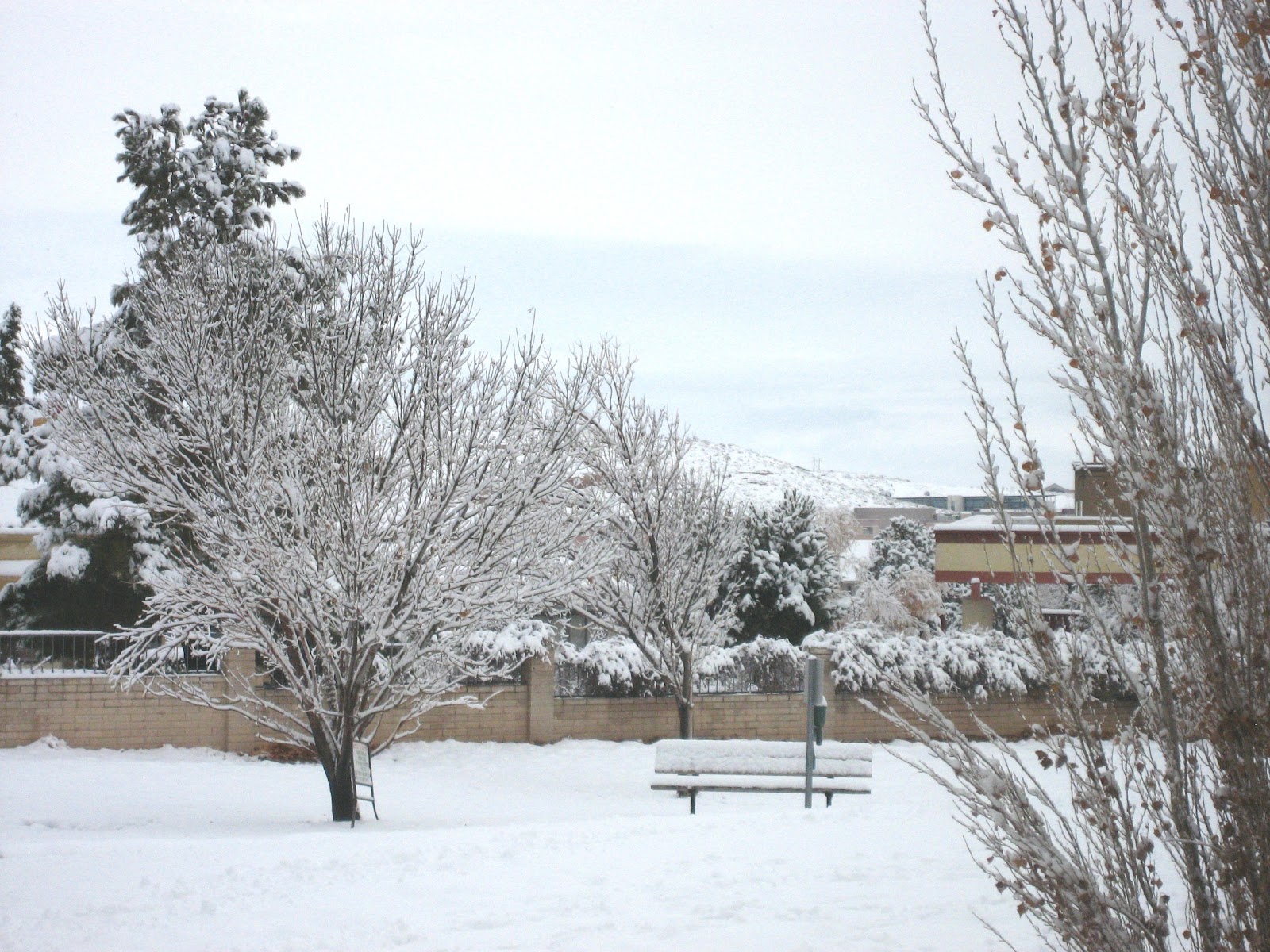
Although the blogger theme is Wordless Wednesday, Tracing the Tribe doubts the snow will still be here then, so here's our morning panorama:
Patches of blue sky are already peeking out from the clouds, so the snow may disappear even sooner.
Tracing the Tribe understands that for those readers who live with this all the time, it may not be as much fun!
For us, it is still a beautiful novelty.
Labels:
#geneabloggers,
#genealogy,
#jewish,
#jewishgenealogy,
New Mexico,
Weather
16 December 2010
RootsTech: Official blogger
Tracing the Tribe is an official RootsTech conference blogger.
In addition to assisting in the effort to get the word out about this new event, which runs from Thursday-Saturday, February 10-12, in Salt Lake City, Utah, I will be presenting on genetic genealogy and participating in a geneablogger's panel (moderated by Thomas MacEntee).
The many presentations demonstrate the increasing role of technology in our quest for information. The sessions cover searching for information, storing it as we find it, and the newest technology available now or coming down the road.
The conference organizers are also extending assistance to the geneabloggers in terms of dedicated spaces to conduct audio interviews and podcasts, video recording of scheduled video interviews with copies to post on our blogs or websites, office space to access the Internet, recharge equipment and assistance in scheduling interviews with speakers and VIPs.
For more information about the event, including registration and the sessions, click here.
Tracing the Tribe hopes to see you in Salt Lake City.
For more information about the event, including registration and the sessions, click here.
Tracing the Tribe hopes to see you in Salt Lake City.
Labels:
#geneabloggers,
#genealogy,
#jewish,
#jewishgenealogy,
Conference,
DNA,
Geneabloggers,
Genetics,
RootsTech 2011,
Utah
Subscribe to:
Posts (Atom)